International Space Station
The International Space Station (ISS) is a modular space laboratory in low Earth orbit, jointly operated by NASA, Roscosmos, ESA, JAXA, and CSA. Launched beginning in 1998, it has been continuously inhabited since November 2000 and supports cutting-edge research in microgravity, Earth observation, and space technology, while fostering international cooperation.
Source: nasa.gov
APODs including "International Space Station"
Discovery in Motion
08/07/2006
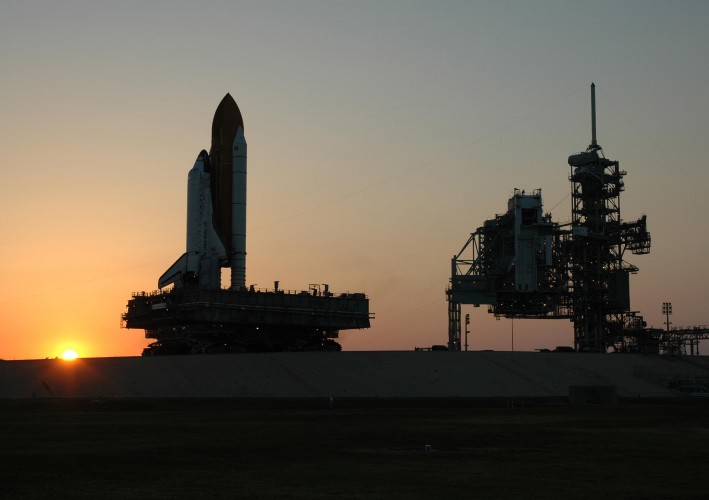
On July 4th, the space shuttle orbiter Discovery rocketed into space on mission STS-121. Now docked with the International Space Station, Discovery orbits planet Earth at about 27 thousand kilometers per hour. But in this dramatic sunset view taken in May, Discovery is approaching the service structures at Kennedy Space Center's launch pad 39B at the blinding speed of (less than) 2 kilometers per hour. Of course, the orbiter, booster rockets, and external fuel tank ride on one of NASA's workhorse crawler transporters. Built for the Apollo program to carry the giant Saturn V rocket, the crawler transporters have seen four decades of service.