International Space Station
The International Space Station (ISS) is a modular space laboratory in low Earth orbit, jointly operated by NASA, Roscosmos, ESA, JAXA, and CSA. Launched beginning in 1998, it has been continuously inhabited since November 2000 and supports cutting-edge research in microgravity, Earth observation, and space technology, while fostering international cooperation.
Source: nasa.gov
APODs including "International Space Station"
A Blue Crescent Moon from Space
20/03/2007
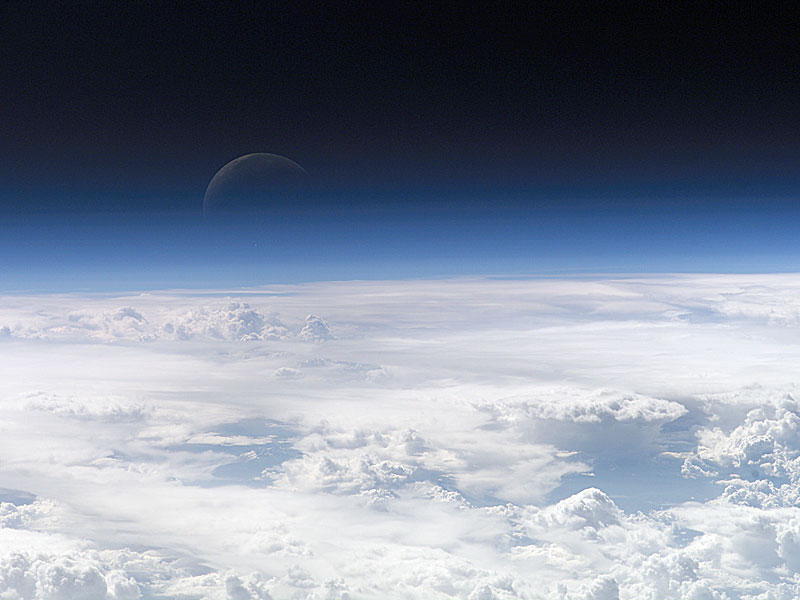
What's happening to the Moon? Drifting around the Earth in 2006 July, astronauts from the International Space Station (ISS) captured a crescent Moon floating far beyond the horizon. The captured above image is interesting because part of the Moon appears blue, and because part of the moon appears missing. Both effects are created by the Earth's atmosphere. Air molecules more efficiently scatter increasingly blue light, making the clear day sky blue for ground observers, and the horizon blue for astronauts. Besides reflecting sunlight, these atmospheric molecules also deflect moonlight, making the lower part of the moon appear to fade away. As one looks higher in the photograph, the increasingly thin atmosphere appears to fade to black.