International Space Station
The International Space Station (ISS) is a modular space laboratory in low Earth orbit, jointly operated by NASA, Roscosmos, ESA, JAXA, and CSA. Launched beginning in 1998, it has been continuously inhabited since November 2000 and supports cutting-edge research in microgravity, Earth observation, and space technology, while fostering international cooperation.
Source: nasa.gov
APODs including "International Space Station"
Columbus Laboratory Installed on Space Station
19/02/2008
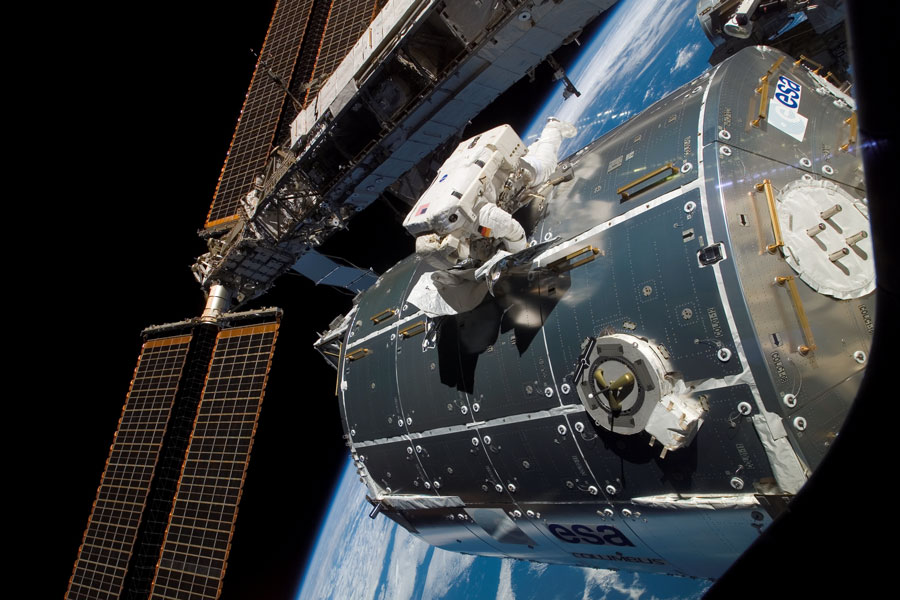
The International Space Station (ISS) has been equipped with a powerful new scientific laboratory. The Space Shuttle Atlantis delivered the Columbus Laboratory to the ISS and installed the seven meter long module over the past week. Columbus has ten racks for experiments that can be controlled from the station or the Columbus Control Center in Germany. The first set of experiments includes the Fluid Science Laboratory that will explore fluid properties in the microgravity of low Earth orbit, and Biolab which supports experiments on microorganisms. Future Columbus experiments include an atomic clock that will test minuscule timing effects including those expected by Einstein's General Theory of Relativity. Pictured above, mission specialist Hans Schlegel works on the outside of Columbus. Scientists from all over the world may propose and carry out experiments to be done on the laboratory during its ten year mission. Watch the Total Lunar Eclipse the night of Feb. 20/21.