International Space Station
The International Space Station (ISS) is a modular space laboratory in low Earth orbit, jointly operated by NASA, Roscosmos, ESA, JAXA, and CSA. Launched beginning in 1998, it has been continuously inhabited since November 2000 and supports cutting-edge research in microgravity, Earth observation, and space technology, while fostering international cooperation.
Source: nasa.gov
APODs including "International Space Station"
Dextre Robot at Work on the Space Station
11/06/2008
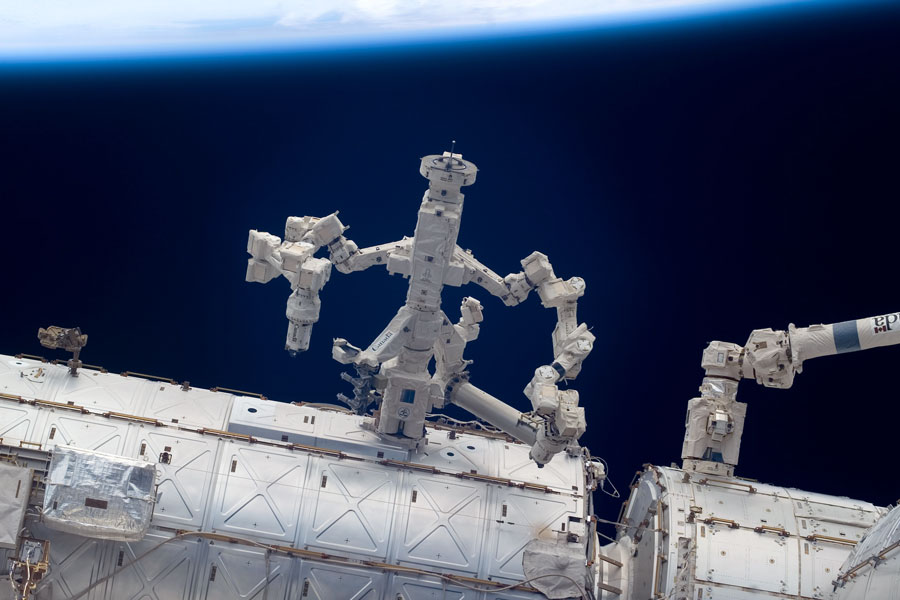
What's the world's most complex space robot doing up there? Last week, Dextre was imaged moving atop the Destiny Laboratory Module of the International Space Station (ISS), completing tasks prior to the deployment of Japan's Kibo pressurized science laboratory. Dextre, short for the Canadian-built Special Purpose Dextrous Manipulator, has arms three meters in length and can attach power tools as fingers. Behind Dextre is the blackness of space, while Earth looms over Dextre's head. The Kibo laboratory segment being deployed during space shuttle Discovery's trip to the ISS can be pressurized and contains racks of scientific experiment that will be used to explore many things, including how plants brace themselves against gravity, and how water might be inhibited from freezing in cells under microgravity. News: GLAST spacecraft reaches orbit