International Space Station
The International Space Station (ISS) is a modular space laboratory in low Earth orbit, jointly operated by NASA, Roscosmos, ESA, JAXA, and CSA. Launched beginning in 1998, it has been continuously inhabited since November 2000 and supports cutting-edge research in microgravity, Earth observation, and space technology, while fostering international cooperation.
Source: nasa.gov
APODs including "International Space Station"
Endeavour in the Moon
20/11/2008
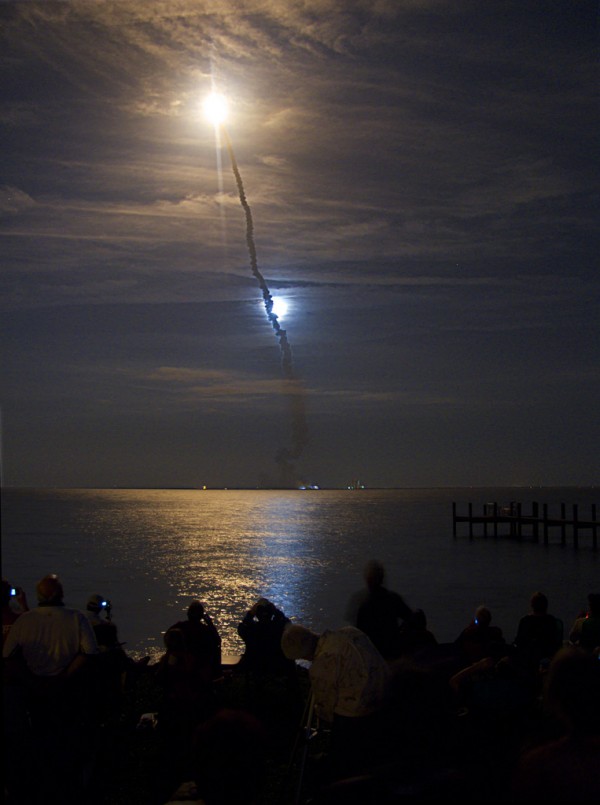
Glaring near the top of the frame, the shuttle orbiter Endeavour rockets into the night on the STS-126 mission. Endeavour left planet Earth on November 14 from Launch Pad 39A at NASA's Kennedy Space Center, making the 27th flight to the International Space Station. To record the dramatic view, the camera was placed so the shuttle's flight path tracked across the Moon, from a vantage point in Indian River City, Florida. Near picture center the almost full, perigee Moon shining through thin clouds silhouettes the shuttle's dense exhaust trail. On board the space station, the crew and the STS-126 astronauts can celebrate the orbital outpost's 10th anniversary today. Construction of the International Space Station officially began with the November 20, 1998 Russian launch of the station's first element, the bus-sized Zarya module.