International Space Station
The International Space Station (ISS) is a modular space laboratory in low Earth orbit, jointly operated by NASA, Roscosmos, ESA, JAXA, and CSA. Launched beginning in 1998, it has been continuously inhabited since November 2000 and supports cutting-edge research in microgravity, Earth observation, and space technology, while fostering international cooperation.
Source: nasa.gov
APODs including "International Space Station"
ISS and Astronaut
10/04/2009
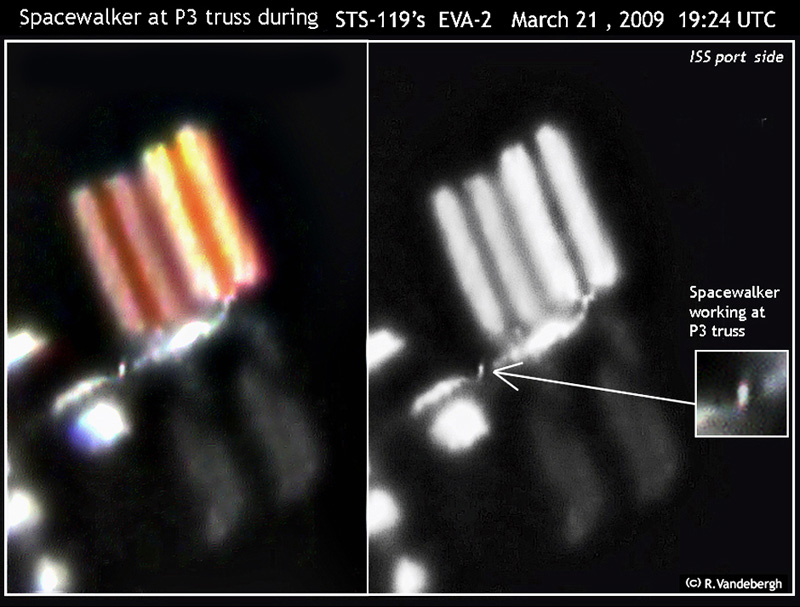
These two frames, taken with a video camera and a telescope, reveal remarkable details of the International Space Station (ISS) orbiting some 350 kilometers above planet Earth. Recorded during last month's visit by the crew of shuttle orbiter Discovery on mission STS-119, the pictures show extended solar arrays glinting in bright sunlight against a dark sky. They also likely capture the blurred image of a spacewalking astronaut during the mission's EVA-2 (Extravehicular Activity-2)! The astronaut is installing equipment along one of the station's truss assemblies. Astronomer Ralf Vandebergh, who often images the ISS during its favorable passes through Dutch skies, comments that no other bright ISS structures occupy the position indicated in the inset, and that a reflective, white-suited astronaut would be visible against the truss and correspond to the bright blur. Vandebergh notes that the timing and location further suggest the spacewalker is STS-119 astronaut Joseph Acaba.