International Space Station
The International Space Station (ISS) is a modular space laboratory in low Earth orbit, jointly operated by NASA, Roscosmos, ESA, JAXA, and CSA. Launched beginning in 1998, it has been continuously inhabited since November 2000 and supports cutting-edge research in microgravity, Earth observation, and space technology, while fostering international cooperation.
Source: nasa.gov
APODs including "International Space Station"
The International Space Station Over the Horizon
07/12/2009
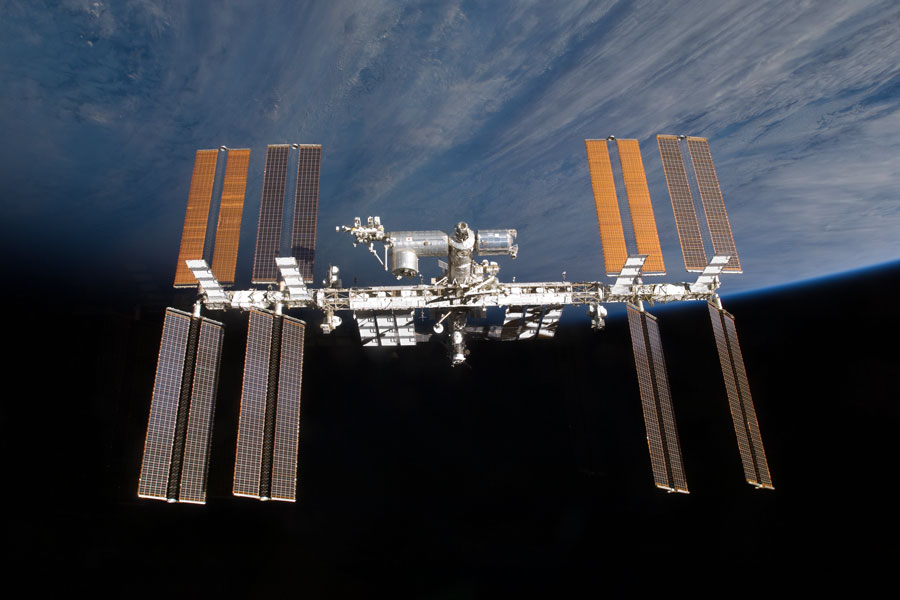
This was home. Just over a week ago, the STS-129 crew of the Space Shuttle Atlantis undocked from the International Space Station (ISS) and returned to Earth. As the shuttle departed the space station, they took the above image. Visible on the ISS are numerous modules, trusses, and long wing-like solar panels. The space shuttle crew spent almost 12 days calling the space station home. The shuttle crew resupplied the space station and delivered valuable spare parts. The ISS continues to be home for five astronauts of Expedition 21. The ISS's crew now includes astronauts representing NASA, the European Space Agency, the Russian Federal Space Agency, and the Canadian Space Agency. New Mirror: APOD now available (again) in Portuguese from Brazil