International Space Station
The International Space Station (ISS) is a modular space laboratory in low Earth orbit, jointly operated by NASA, Roscosmos, ESA, JAXA, and CSA. Launched beginning in 1998, it has been continuously inhabited since November 2000 and supports cutting-edge research in microgravity, Earth observation, and space technology, while fostering international cooperation.
Source: nasa.gov
APODs including "International Space Station"
The International Space Station from Above
03/03/2010
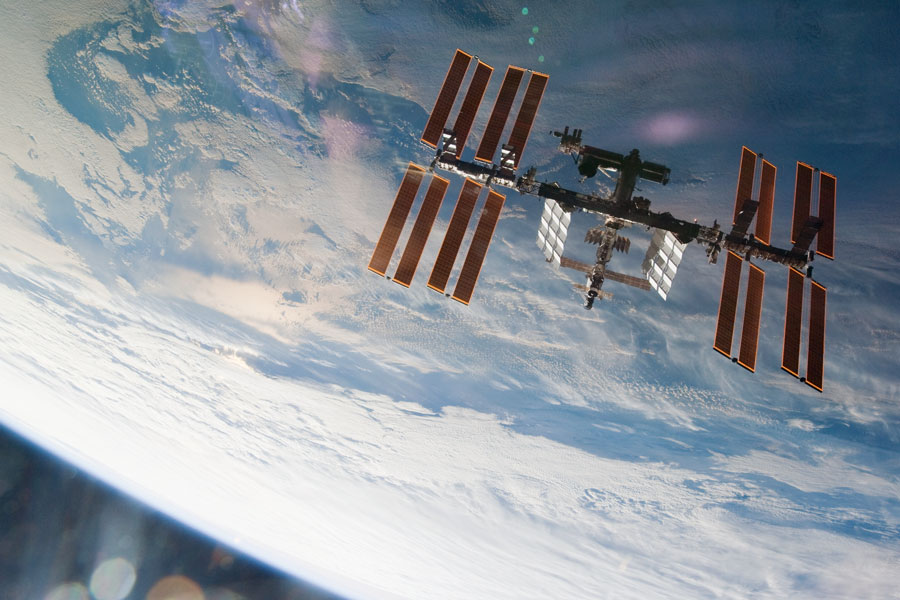
The International Space Station (ISS) is the largest human-made object ever to orbit the Earth. The ISS is so large that it can be seen drifting overhead with the unaided eye, and is frequently imaged from the ground in picturesque fashion. Last month, the station was visited again by space shuttle, which resupplied the station and added a new module. The ISS is currently operated by the Expedition 22 crew, now consisting five astronauts including two supplied by USA's NASA, two by Russia's RKA, and one by Japan's JAXA. After departing the ISS, the crew of the space shuttle Endeavour captured the above spectacular vista of the orbiting space city high above the clouds, waters, and lands of Earth. Visible components include modules, trusses, and expansive solar arrays that gather sunlight that is turned into needed electricity. Share Quiz: Can anyone identify the landscape behind the space station?