International Space Station
The International Space Station (ISS) is a modular space laboratory in low Earth orbit, jointly operated by NASA, Roscosmos, ESA, JAXA, and CSA. Launched beginning in 1998, it has been continuously inhabited since November 2000 and supports cutting-edge research in microgravity, Earth observation, and space technology, while fostering international cooperation.
Source: nasa.gov
APODs including "International Space Station"
Discovery's Cloud
08/04/2010
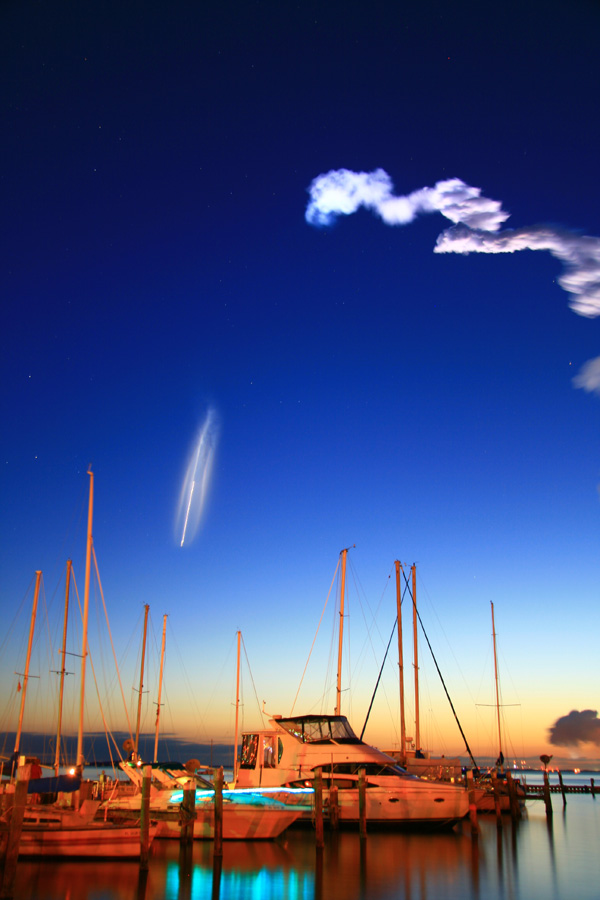
The space shuttle orbiter Discovery is now docked with the International Space Station, some 350 kilometers above planet Earth. Last Monday, its launch to orbit was a beautiful one as it rose into clear, predawn skies at 6:21am EDT from Kennedy Space Center's pad 39A. Looking east, this time exposure was taken shortly after lift off from a marina about 13 miles west of the launch site in Titusville, Florida. It shows the dawn's emerging colors along the horizon, with wafting rocket contrails at the upper right. The bright streak surrounded by the remarkable, elongated, vapor cloud near the center of the image is the actual track of Discovery, arcing toward the horizon and its orbital rendezvous.