International Space Station
The International Space Station (ISS) is a modular space laboratory in low Earth orbit, jointly operated by NASA, Roscosmos, ESA, JAXA, and CSA. Launched beginning in 1998, it has been continuously inhabited since November 2000 and supports cutting-edge research in microgravity, Earth observation, and space technology, while fostering international cooperation.
Source: nasa.gov
APODs including "International Space Station"
Eclipsing the Sun
05/01/2011
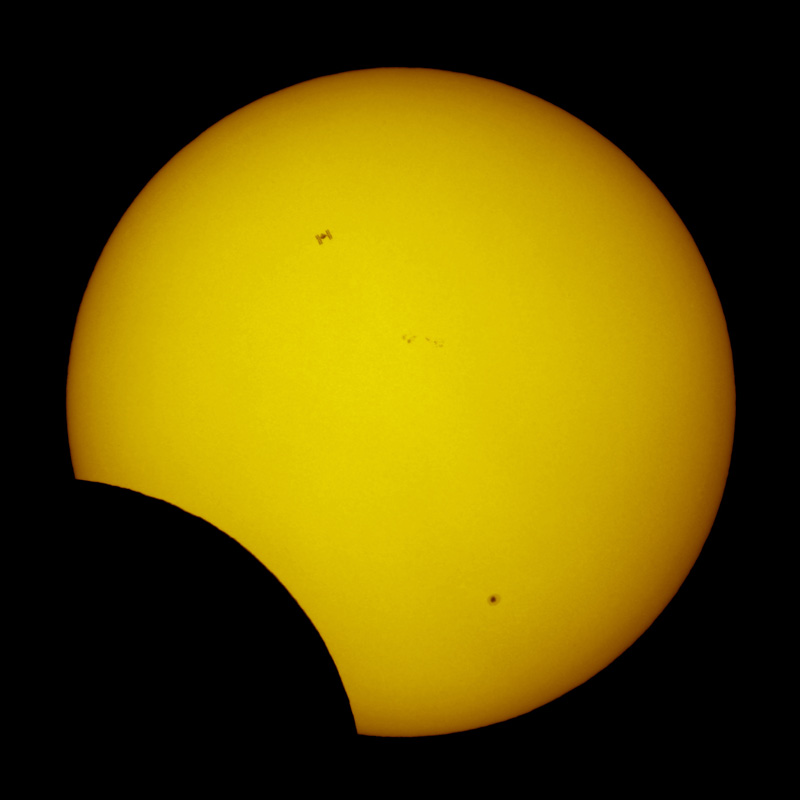
Skywatchers throughout much of Europe, North Africa, and Central Asia, were treated to the first eclipse of the new year on January 4, a partial eclipse of the Sun. But traveling to the area around Muscat, capital city of Oman, photographer Thierry Legault planned to simultaneously record two eclipses on that date, calculating from that position, for a brief moment, both the Moon and the International Space Station could be seen in silhouette, crossing the Sun. His sharp, 1/5000th second exposure is shown here, capturing planet Earth's two largest satellites against the bright solar disk. As the partial solar eclipse unfolded, the space station (above and left of center) zipped across the scene in less than 1 second, about 500 kilometers from the photographer's telescope and camera. Of course, the Moon was 400 thousand kilometers away. Complete with sunspots, the Sun was 150 million kilometers distant. Best Astronomy Images: APOD Editor to speak in Philadelphia tonight and NYC Friday