International Space Station
The International Space Station (ISS) is a modular space laboratory in low Earth orbit, jointly operated by NASA, Roscosmos, ESA, JAXA, and CSA. Launched beginning in 1998, it has been continuously inhabited since November 2000 and supports cutting-edge research in microgravity, Earth observation, and space technology, while fostering international cooperation.
Source: nasa.gov
APODs including "International Space Station"
Planets, Endeavour at Dawn
21/05/2011
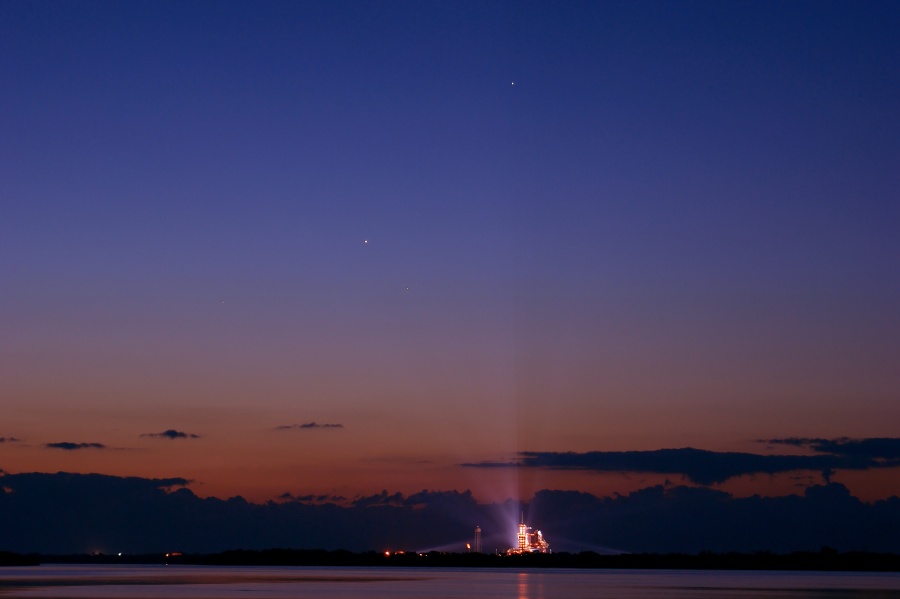
When dawn broke over Kennedy Space Center on Monday, May 16, the space shuttle orbiter Endeavour still stood on pad 39A. Its final launch, on mission STS-134 to the International Space Station, was only hours away. Shining through the early morning twilight four planets were also poised above the eastern horizon, a moving scene captured here from across the Banana River at the center's Saturn V VIP viewing site. Scattered by planet Earth's dense atmosphere, floodlight beams play over the launch pad, glancing skyward toward the celestial beacons. Jupiter is highest, near the top of the frame, but even the solar sytem's ruling gas giant is outshone by brilliant Venus near picture center. Innermost planet Mercury is below Venus, to the right. Below and left, Mars almost fades into the twilight glow. The four planets continue to hug the eastern horizon at dawn throughout the month, while Endeavour is now scheduled to make its final approach to planet Earth on June 1.