International Space Station
The International Space Station (ISS) is a modular space laboratory in low Earth orbit, jointly operated by NASA, Roscosmos, ESA, JAXA, and CSA. Launched beginning in 1998, it has been continuously inhabited since November 2000 and supports cutting-edge research in microgravity, Earth observation, and space technology, while fostering international cooperation.
Source: nasa.gov
APODs including "International Space Station"
Last Roll Out of a NASA Space Shuttle
20/06/2011
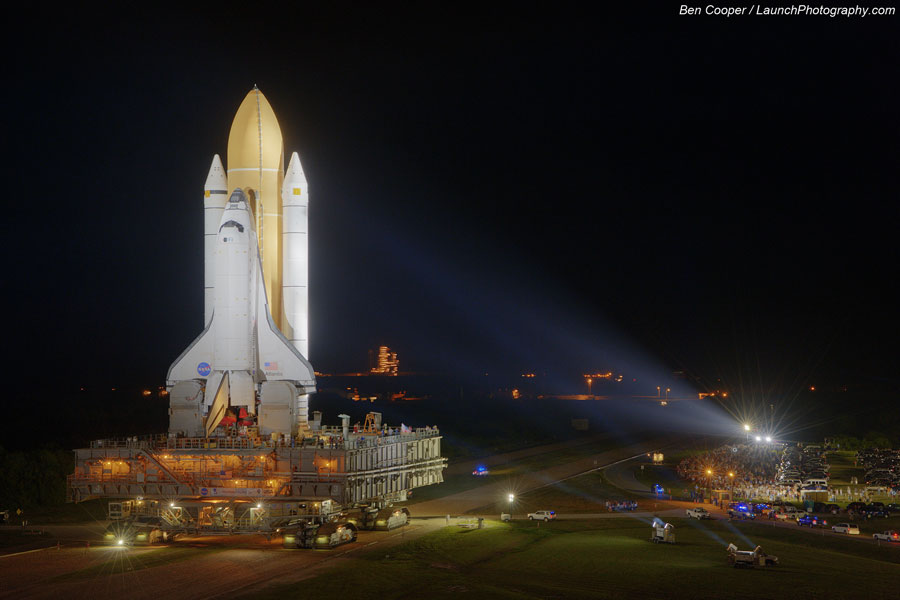
In the final move of its kind, NASA's space shuttle Atlantis was photographed earlier this month slowly advancing toward Launch Pad 39A, where it is currently scheduled for a July launch to the International Space Station. The mission, designated STS-135, is the 135th and last mission for a NASA space shuttle. Atlantis and its four-person crew will be carrying, among other things, the Multi-Purpose Logistics Module Raffaello to bring key components and supplies to the ISS. Pictured above, the large Shuttle Crawler Transporter rolls the powerful orbiter along the five-kilometer long road at less than two kilometers per hour. Over 15,000 spectators, some visible on the right, were on hand for the historic roll out.