International Space Station
The International Space Station (ISS) is a modular space laboratory in low Earth orbit, jointly operated by NASA, Roscosmos, ESA, JAXA, and CSA. Launched beginning in 1998, it has been continuously inhabited since November 2000 and supports cutting-edge research in microgravity, Earth observation, and space technology, while fostering international cooperation.
Source: nasa.gov
APODs including "International Space Station"
Jupiter and the Moons of Earth
27/04/2012
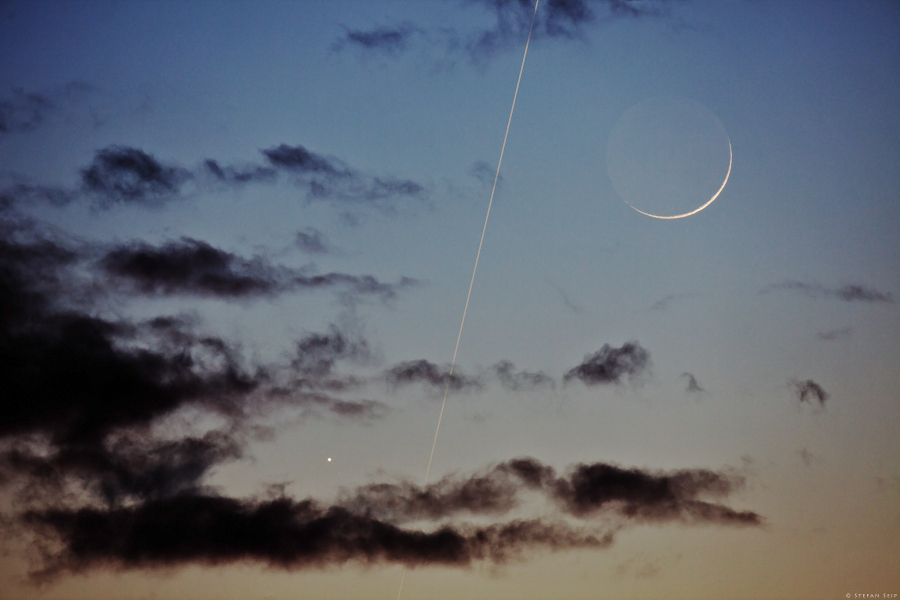
Planet Earth has many moons. Its largest artifical moon, the International Space Station, streaks through this lovely skyview with clouds in silhouette against the fading light of a sunset. Captured from Stuttgart, Germany last Sunday, the frame also includes Earth's largest natural satellite 1.5 days after its New Moon phase. Just below and left of the young crescent is Jupiter, another bright celestial beacon hovering near the western horizon in early evening skies. Only briefly, as seen from the photographer's location, Jupiter and these moons of Earth formed the remarkably close triple conjunction. Of course, Jupiter has many moons too. In fact, close inspection of the photo will reveal tiny pin pricks of light near the bright planet, large natural satellites of Jupiter known as Galilean moons.