International Space Station
The International Space Station (ISS) is a modular space laboratory in low Earth orbit, jointly operated by NASA, Roscosmos, ESA, JAXA, and CSA. Launched beginning in 1998, it has been continuously inhabited since November 2000 and supports cutting-edge research in microgravity, Earth observation, and space technology, while fostering international cooperation.
Source: nasa.gov
APODs including "International Space Station"
Space Station Lookout
10/04/2013
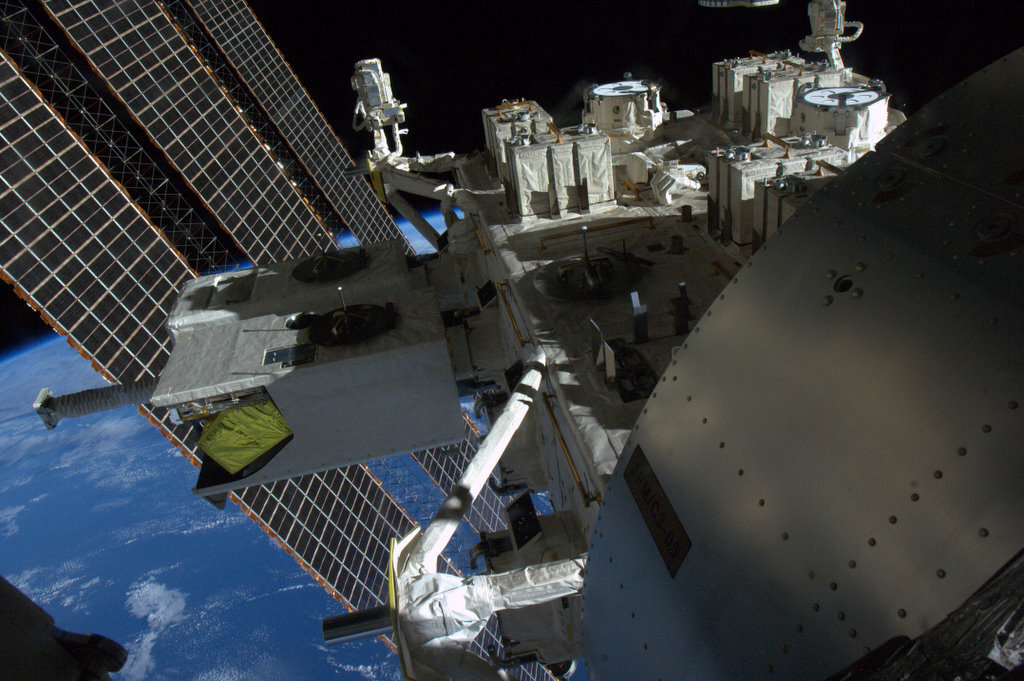
If you glanced out a side window of the International Space Station, what might you see? If you were Expedition 34 flight engineer Chris Hadfield, and you were looking out one of windows of Japan's Kibo Research Module on February 26, you might have seen the above vista. In the distance lies the darkness of outer space and the blueness of planet Earth. Large ISS objects include long solar panels that stretch diagonally from the upper left and the cylindrical airlock of the Pressurized Module that occupies the lower right. Numerous ports and platforms of the space station are visible and labeled on an annotated companion image. Of particular note is what looks to be a washer - dryer pair toward the image left, which are really NASA's HREP (near) and JAXA's MCE (far) research platforms. The gold foil covered experiment in the rear of HREP is the Remote Atmospheric and Ionospheric Detection System (RAIDS) that monitors atmospheric airglow, while MCE includes the Global Lightning and Sprite Measurements (JEM-GLIMS) instrument that monitors atmospheric electrical discharges. The current Expedition 35 crew is now commanded by Colonel Hadfield and scheduled to stay aboard the space station until May. Follow APOD in Spanish: On the web with Observatorio and on Facebook with Universo