International Space Station
The International Space Station (ISS) is a modular space laboratory in low Earth orbit, jointly operated by NASA, Roscosmos, ESA, JAXA, and CSA. Launched beginning in 1998, it has been continuously inhabited since November 2000 and supports cutting-edge research in microgravity, Earth observation, and space technology, while fostering international cooperation.
Source: nasa.gov
APODs including "International Space Station"
Antares Rocket Launch
21/09/2013
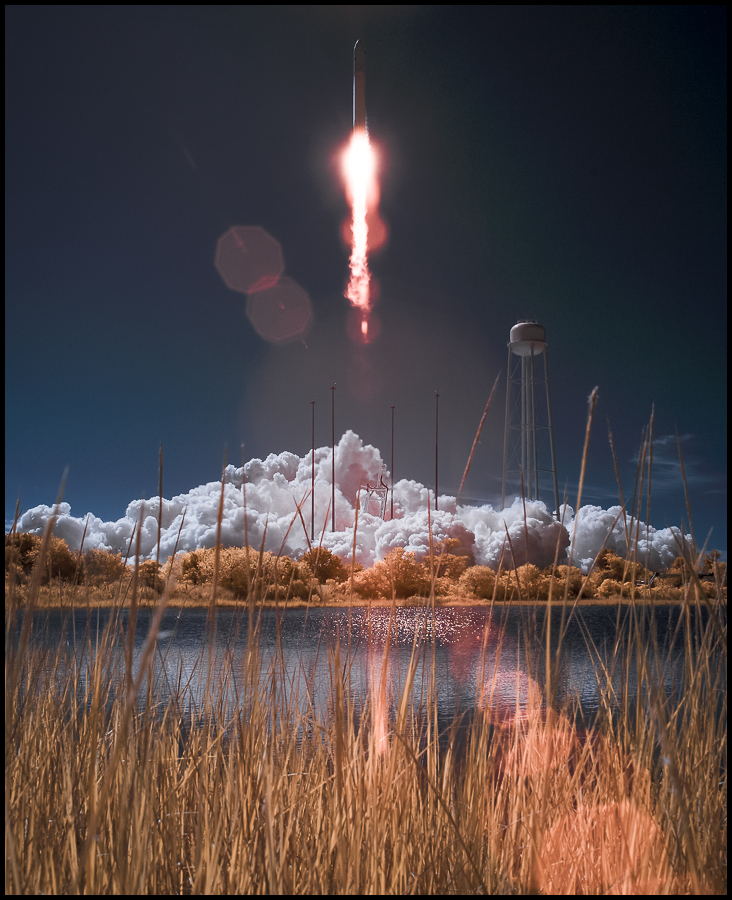
The sky looks dark in this scene from the Mid-Atlantic Regional Spaceport (MARS) at NASA Wallops Flight Facility, Virginia. Captured on Wednesday, September 18, an Orbital Sciences Corporation Antares rocket is leaving launch pad-0A with the Cygnus cargo spacecraft aboard. Though it looks like night, the photograph was taken at 10:58am EDT, under bright, clear morning skies, with a digital camera modified to record infrared images. The Sun itself is above and left of the picture frame, creating strong glare and internal reflections in the camera lens at near-infrared wavelengths. In the false-color presentation, the vegetation and watery reflections also take on an otherworldly pallor. Reaching orbit, the Cygnus spacecraft is now on its way to a Sunday rendezvous with the International Space Station. The spacecraft will deliver about 1,300 pounds (589 kilograms) of cargo to the Expedition 37 crew.