International Space Station
The International Space Station (ISS) is a modular space laboratory in low Earth orbit, jointly operated by NASA, Roscosmos, ESA, JAXA, and CSA. Launched beginning in 1998, it has been continuously inhabited since November 2000 and supports cutting-edge research in microgravity, Earth observation, and space technology, while fostering international cooperation.
Source: nasa.gov
APODs including "International Space Station"
Space Station Detector Finds Unexplained Positron Excess
06/10/2014
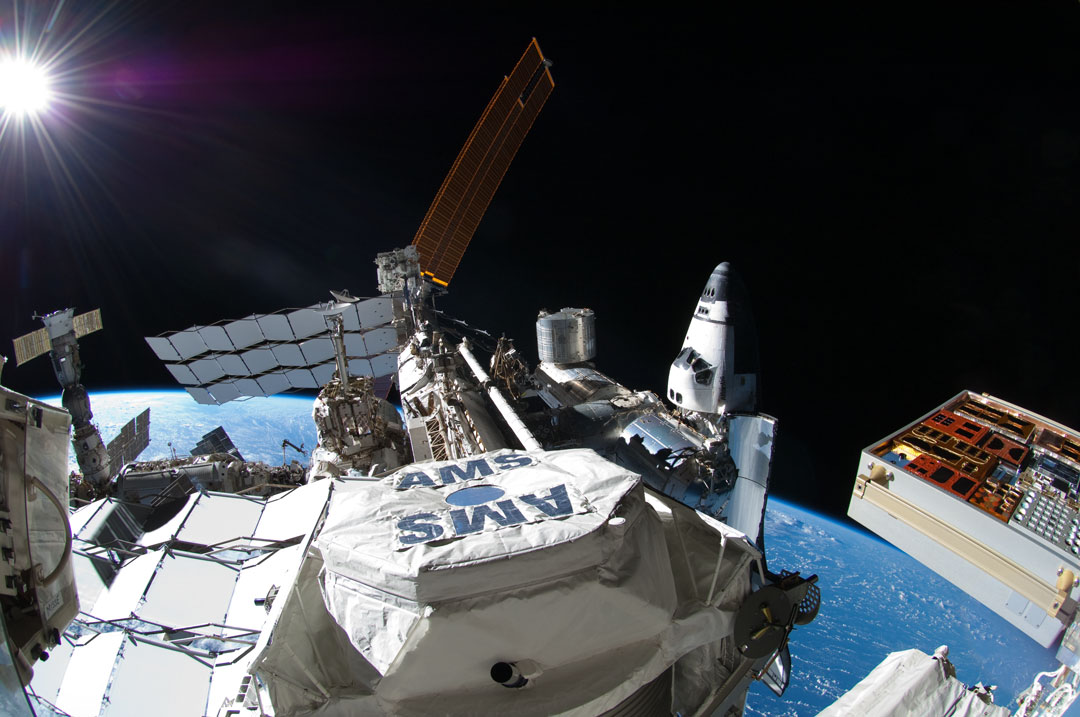
Where did all these high energy positrons come from? The Alpha Magnetic Spectrometer (AMS-02) onboard the International Space Station (ISS) has been meticulously recording how often it is struck by both high energy electrons and positrons since 2011. After accumulating years of data, it has now become clear that there are significantly more positrons than expected at the highest energies detected. The excess may have a very exciting and profound origin -- the annihilation of distant but previously undetected dark matter particles. However, it is also possible that astronomical sources such as pulsars are creating the unexplained discrepancy. The topic remains a very active area of research. Pictured here, the AMS is visible on the ISS just after being installed, with a US Space Shuttle docked on the far right, a Russian Soyuz capsule docked on the far left, and the blue Earth that houses all nations visible across the background. Follow APOD on: Facebook, Google Plus, or Twitter