International Space Station
The International Space Station (ISS) is a modular space laboratory in low Earth orbit, jointly operated by NASA, Roscosmos, ESA, JAXA, and CSA. Launched beginning in 1998, it has been continuously inhabited since November 2000 and supports cutting-edge research in microgravity, Earth observation, and space technology, while fostering international cooperation.
Source: nasa.gov
APODs including "International Space Station"
The ISS and a Colorful Moon
31/07/2015
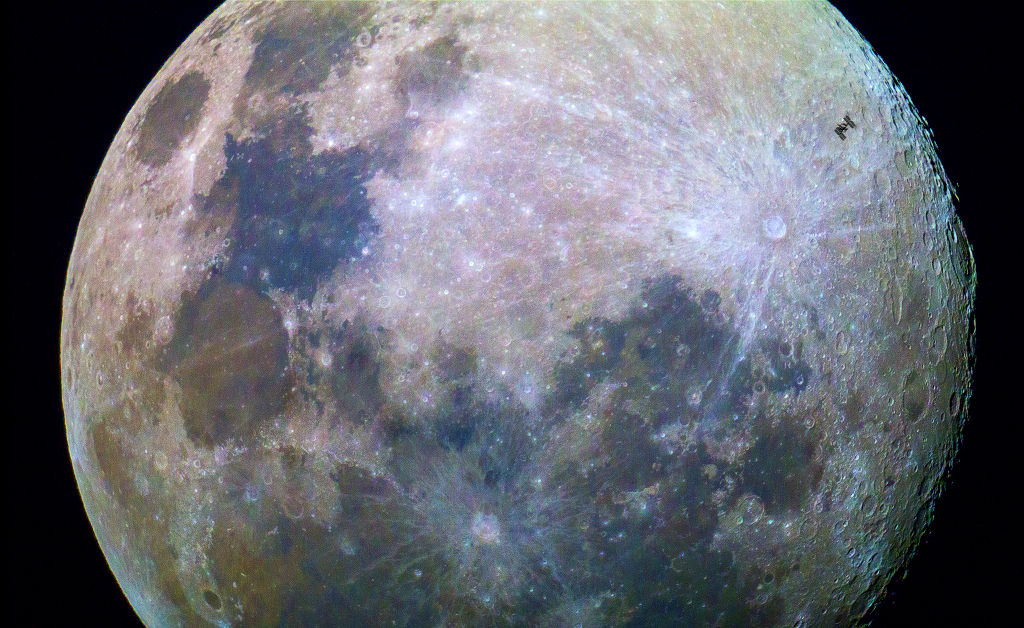
Tonight's Full Moon, the second Full Moon in July, could be called a blue moon according to modern folklore. But this sharp and detailed mosaic, recorded with telescope and digital camera just before July's first Full Moon, actually does show a colorful lunar surface. The colors have been enhanced in the processed image but are real nonetheless, corresponding to real differences in the chemical makeup of the lunar surface. Also easy to see especially when the Moon is near full phase, bright rays from 85 kilometer wide Tycho crater at the upper right extend far across the lunar surface. Against the southern lunar highlands above and right of Tycho is an amazingly detailed silhouette of the International Space Station. Seen from Byron Bay, NSW Australia on June 30, the ISS lunar transit lasted about 1/3 of a second, captured with a fast shutter speed in burst mode.