International Space Station
The International Space Station (ISS) is a modular space laboratory in low Earth orbit, jointly operated by NASA, Roscosmos, ESA, JAXA, and CSA. Launched beginning in 1998, it has been continuously inhabited since November 2000 and supports cutting-edge research in microgravity, Earth observation, and space technology, while fostering international cooperation.
Source: nasa.gov
APODs including "International Space Station"
Earth and Milky Way from Space
07/11/2015
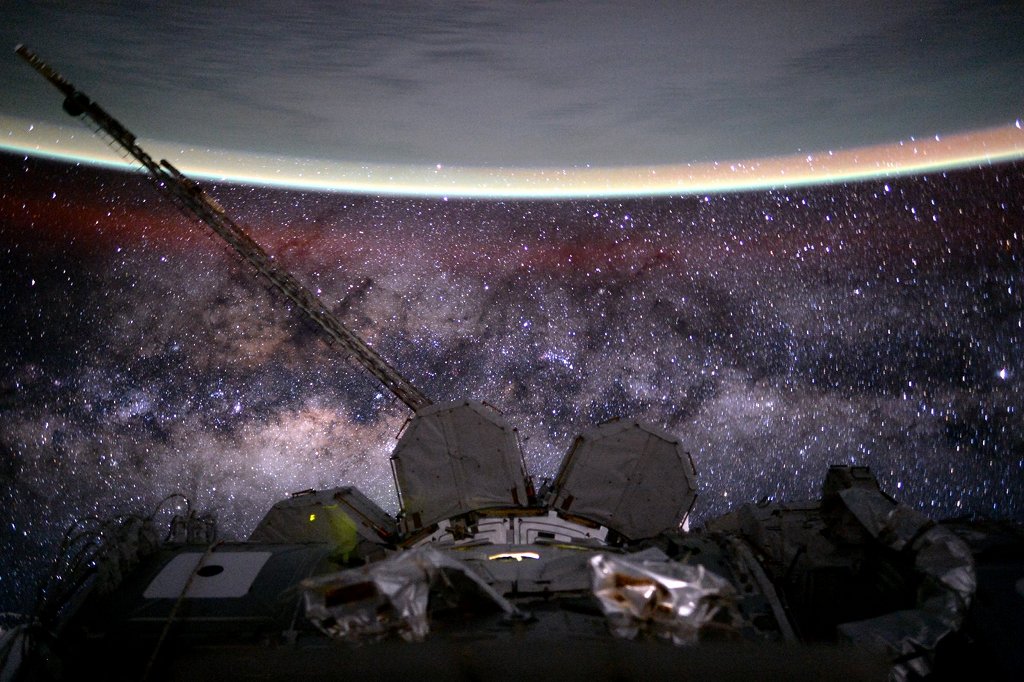
Since November 2000, people have been living continuously on the International Space Station. To celebrate humanity's 15th anniversary off planet Earth, consider this snapshot from space of our galaxy and our home world posing together beyond the orbital outpost. The Milky Way stretches below the curve of Earth's limb in the scene that also records a faint red, extended airglow. The galaxy's central bulge appears with starfields cut by dark rifts of obscuring interstellar dust. The picture was taken by Astronaut Scott Kelly on August 9, 2015, the 135th day of his one-year mission in space.