International Space Station
The International Space Station (ISS) is a modular space laboratory in low Earth orbit, jointly operated by NASA, Roscosmos, ESA, JAXA, and CSA. Launched beginning in 1998, it has been continuously inhabited since November 2000 and supports cutting-edge research in microgravity, Earth observation, and space technology, while fostering international cooperation.
Source: nasa.gov
APODs including "International Space Station"
The International Space Station over Earth
18/04/2016
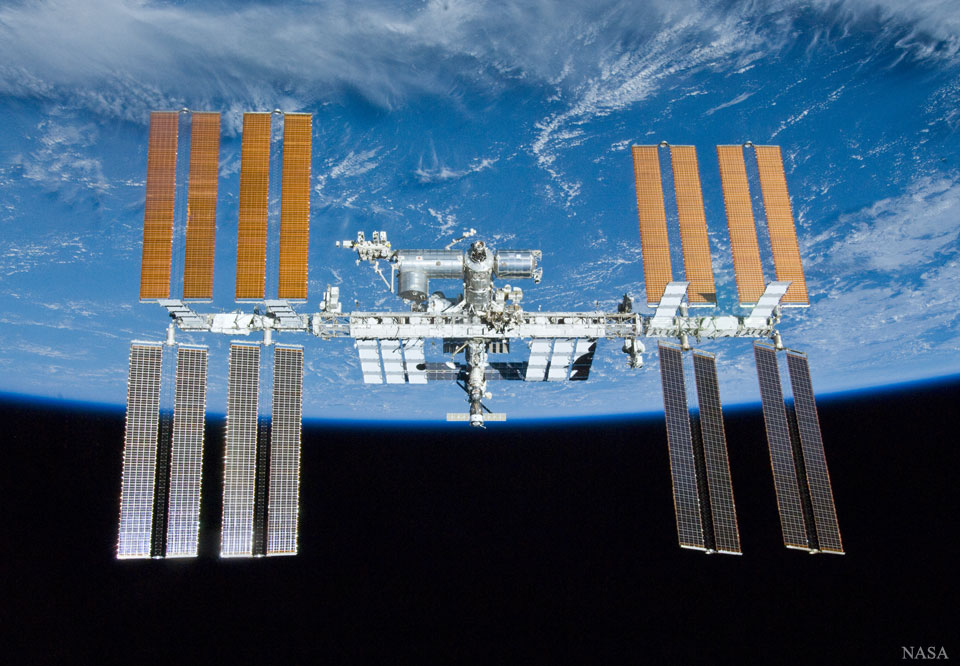
The International Space Station is the largest object ever constructed by humans in space. The station perimeter extends over roughly the area of a football field, although only a small fraction of this is composed of modules habitable by humans. The station is so large that it could not be launched all at once -- it continues to be built piecemeal. To function, the ISS needs huge trusses, some over 15 meters long and with masses over 10,000 kilograms, to keep it rigid and to route electricity and liquid coolants. Pictured above, the immense space station was photographed from the now-retired space shuttle Atlantis after a week-long stay in 2010. Across the image top hangs part of a bright blue Earth, in stark contrast to the darkness of interstellar space across the bottom.