International Space Station
The International Space Station (ISS) is a modular space laboratory in low Earth orbit, jointly operated by NASA, Roscosmos, ESA, JAXA, and CSA. Launched beginning in 1998, it has been continuously inhabited since November 2000 and supports cutting-edge research in microgravity, Earth observation, and space technology, while fostering international cooperation.
Source: nasa.gov
APODs including "International Space Station"
Highlights of the Winter Sky
12/12/2017
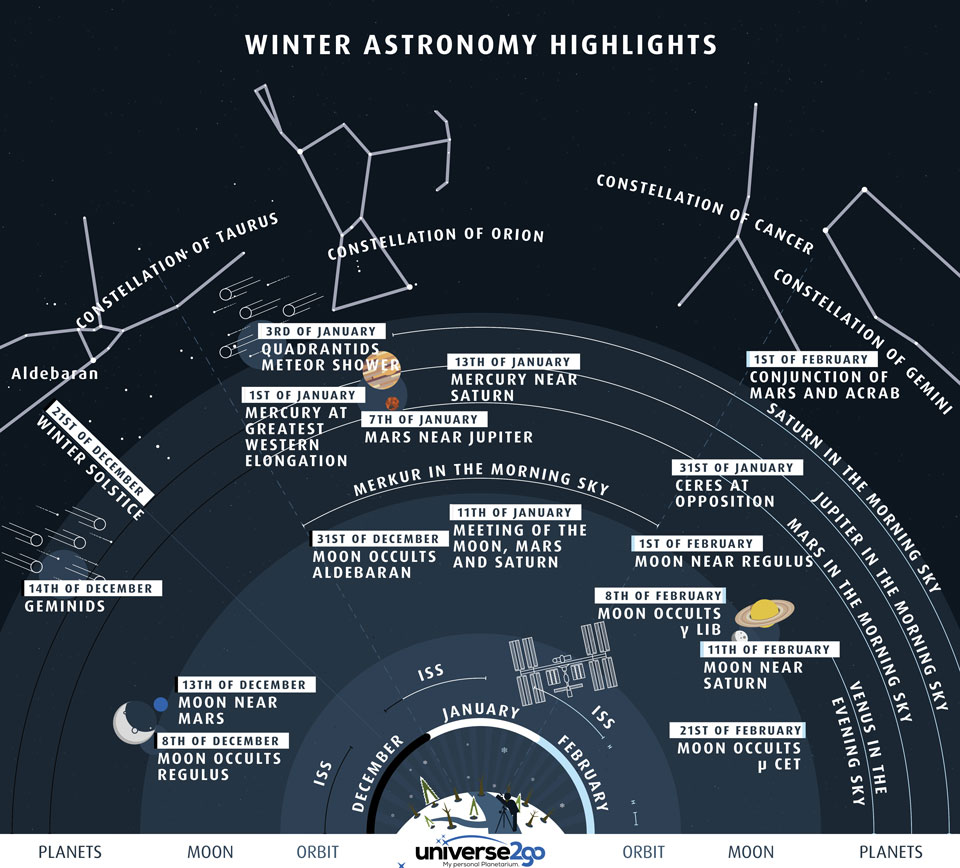
What's up in the sky this winter? The featured graphic gives a few highlights for Earth's northern hemisphere. Viewed as a clock face centered at the bottom, early winter sky events fan out toward the left, while late winter events are projected toward the right. Objects relatively close to Earth are illustrated, in general, as nearer to the cartoon figure with the telescope at the bottom center -- although almost everything pictured can be seen without a telescope. Highlights of this winter's sky include the Geminids meteor shower peaking this week, the constellation of Orion becoming notable in the evening sky, and many planets being visible before sunrise in February. As true in every season, the International Space Station (ISS) can be sometimes be found drifting across your sky if you know just when and where to look.