International Space Station
The International Space Station (ISS) is a modular space laboratory in low Earth orbit, jointly operated by NASA, Roscosmos, ESA, JAXA, and CSA. Launched beginning in 1998, it has been continuously inhabited since November 2000 and supports cutting-edge research in microgravity, Earth observation, and space technology, while fostering international cooperation.
Source: nasa.gov
APODs including "International Space Station"
Dawn's Early Light, Rocket's Red Glare
04/07/2018
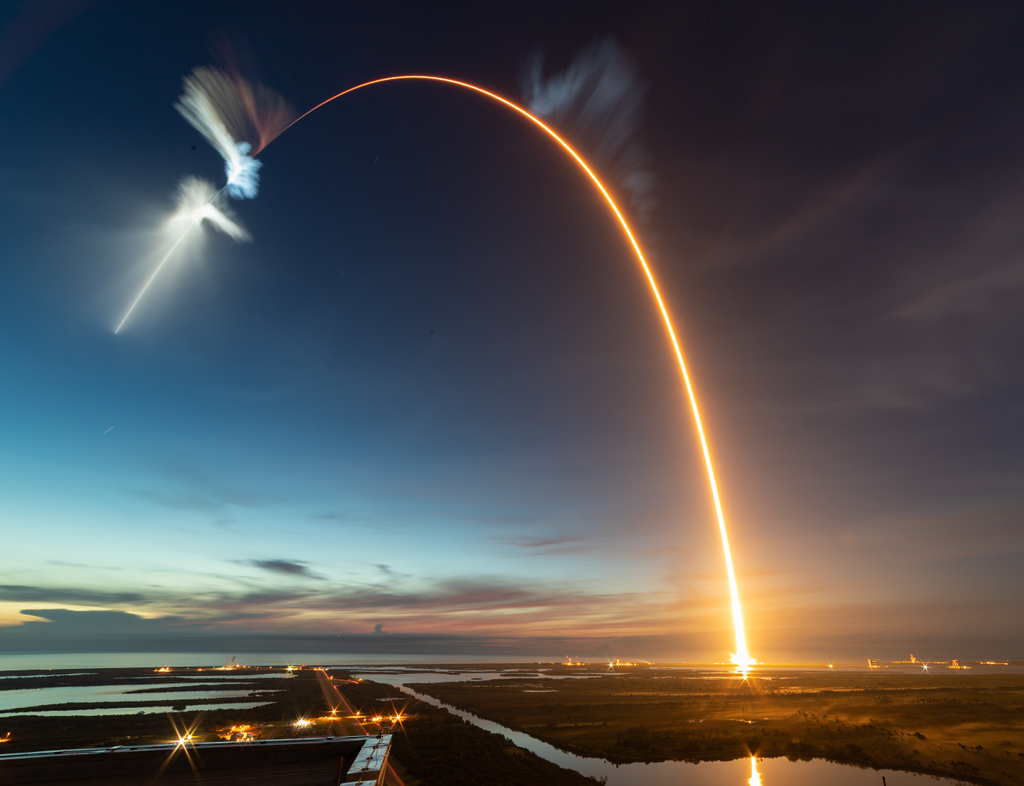
If you saw the dawn's early light from Cape Canaveral Air Force Station last Friday, June 29, then you could have seen this rocket's red glare. The single 277-second long exposure, made from the roof of NASA's Vehicle Assembly building, shows a predawn Falcon 9 launch, the rocket streaking eastward into the sky about 45 minutes before sunrise. At high altitude, its stage separation plume is brightly lit by the Sun still below the eastern horizon. The Falcon 9 rocket's first stage had been launched before, lofting the Transiting Exoplanet Survey Satellite (TESS) into orbit on April 18, only 72 days earlier. For this launch of SpaceX Commercial Resupply Service mission 15 (CRS-15) it carried an also previously flown Dragon capsule. But no further reuse of this Falcon 9 was planned so no dramatic first stage landing followed the launch. The Dragon capsule arrived at the International Space Station on July 2.