International Space Station
The International Space Station (ISS) is a modular space laboratory in low Earth orbit, jointly operated by NASA, Roscosmos, ESA, JAXA, and CSA. Launched beginning in 1998, it has been continuously inhabited since November 2000 and supports cutting-edge research in microgravity, Earth observation, and space technology, while fostering international cooperation.
Source: nasa.gov
APODs including "International Space Station"
NICER at Night
01/06/2019
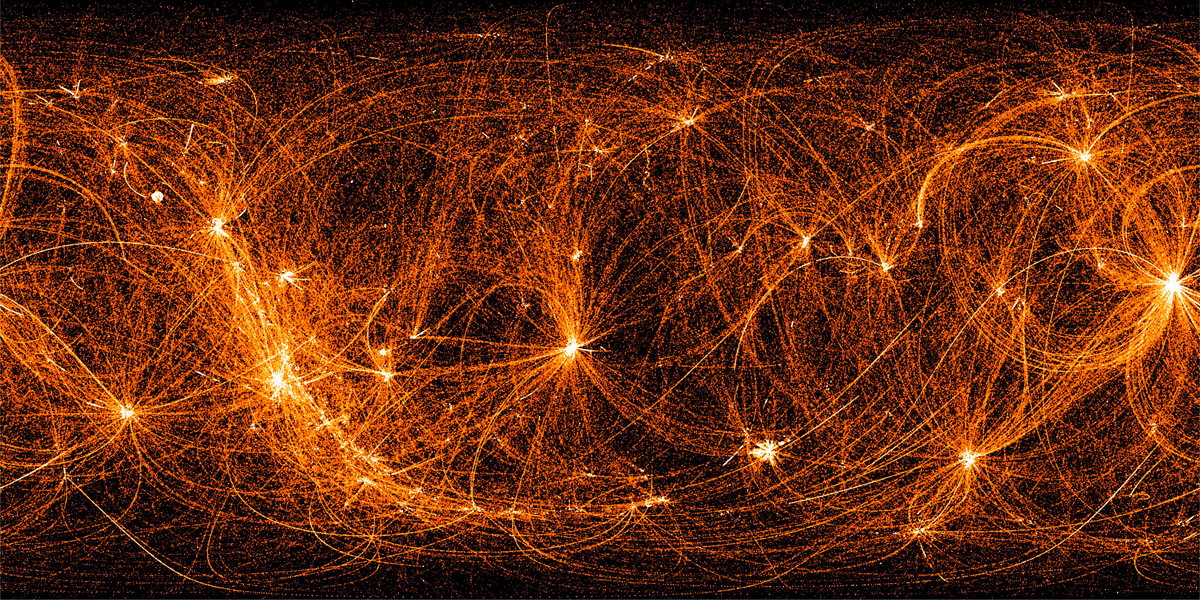
A payload on board the International Space Station, the Neutron star Interior Composition Explorer (NICER) twists and turns to track cosmic sources of X-rays as the station orbits planet Earth every 93 minutes. During orbit nighttime, its X-ray detectors remain on. So as NICER slews from target to target bright arcs and loops are traced across this all-sky map made from 22 months of NICER data. The arcs tend to converge on prominent bright spots, pulsars in the X-ray sky that NICER regularly targets and monitors. The pulsars are spinning neutron stars that emit clock-like pulses of X-rays. Their timing is so precise it can be used for navigation, determining spacecraft speed and position. This NICER X-ray, all-sky, map is composed in coordinates with the celestial equator horizontally across the center.