International Space Station
The International Space Station (ISS) is a modular space laboratory in low Earth orbit, jointly operated by NASA, Roscosmos, ESA, JAXA, and CSA. Launched beginning in 1998, it has been continuously inhabited since November 2000 and supports cutting-edge research in microgravity, Earth observation, and space technology, while fostering international cooperation.
Source: nasa.gov
APODs including "International Space Station"
The Traffic in Taurus
03/04/2020
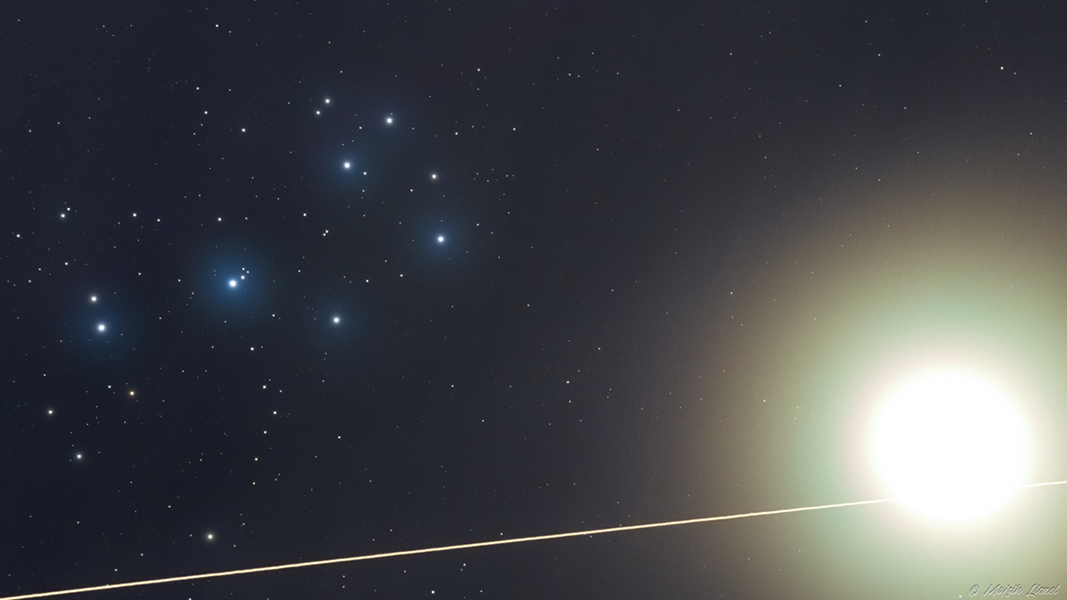
There's a traffic jam in Taurus lately. On April 1, this celestial frame from slightly hazy skies over Tapiobicske, Hungary recorded an impressive pile up toward the zodiacal constellation of the Bull and the Solar System's ecliptic plane. Streaking right to left the International Space Station speeds across the bottom of the telescopic field of view. Wandering about as far from the Sun in planet Earth's skies as it can get, inner planet Venus is bright and approaching much slower, overexposed at the right. Bystanding at the upper left are the sister stars of the Pleiades. No one has been injured in the close encounter though, because it really isn't very close. Continuously occupied since November 2000, the space station orbits some 400 kilometers above the planet's surface. Venus, currently the brilliant evening star, is almost 2/3 of an astronomical unit away. A more permanent resident of Taurus, the Pleiades star cluster is 400 light-years distant.