International Space Station
The International Space Station (ISS) is a modular space laboratory in low Earth orbit, jointly operated by NASA, Roscosmos, ESA, JAXA, and CSA. Launched beginning in 1998, it has been continuously inhabited since November 2000 and supports cutting-edge research in microgravity, Earth observation, and space technology, while fostering international cooperation.
Source: nasa.gov
APODs including "International Space Station"
Comet NEOWISE from the ISS
10/07/2020
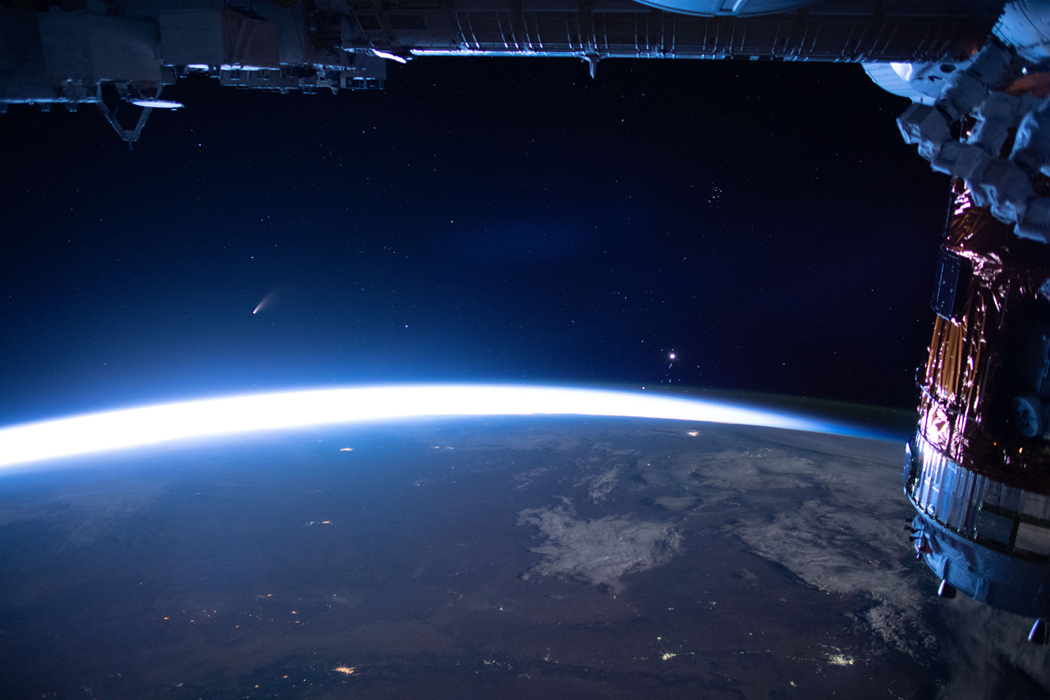
Rounding the Sun on July 3rd and currently headed for the outer Solar System, Comet NEOWISE (C/2020 F3) has been growing brighter in the predawn skies of planet Earth. From low Earth orbit it also rises before the Sun, captured above the approaching glow along the eastern horizon in this snapshot from the International Space Station on July 5. Venus, now Earth's morning star is the brilliant celestial beacon on the right in the field of view. Above Venus you can spot the sister stars of the more compact Pleiades cluster. Earthbound skygazers can spot this comet with the unaided eye, but should look for awesome views with binoculars. Comet NEOWISE from Earth's Surface: Notable Images Submitted to APOD