International Space Station
The International Space Station (ISS) is a modular space laboratory in low Earth orbit, jointly operated by NASA, Roscosmos, ESA, JAXA, and CSA. Launched beginning in 1998, it has been continuously inhabited since November 2000 and supports cutting-edge research in microgravity, Earth observation, and space technology, while fostering international cooperation.
Source: nasa.gov
APODs including "International Space Station"
Shuttle Over Earth
17/04/2022
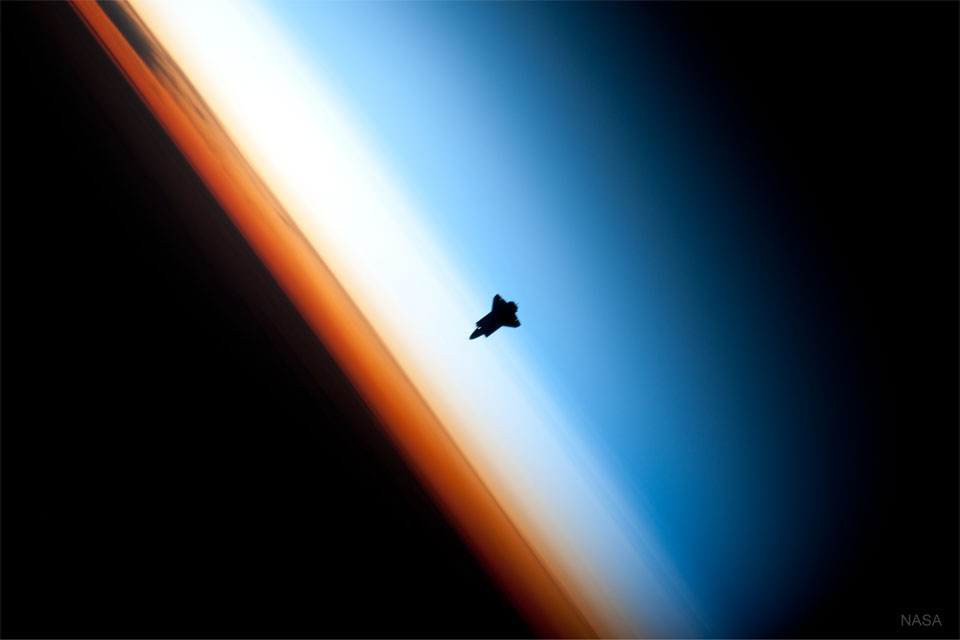
What's that approaching? Astronauts on board the International Space Station in 2010 first saw it far in the distance. Soon it enlarged to become a dark silhouette. As it came even closer, the silhouette appeared to be a spaceship. Finally, the object revealed itself to be the Space Shuttle Endeavour, and it soon docked as expected with the Earth-orbiting space station. Pictured here, Endeavour was imaged near Earth's horizon as it approached, where several layers of the Earth's atmosphere were visible. Directly behind the shuttle is the mesosphere, which appears blue. The atmospheric layer that appears white is the stratosphere, while the orange layer is Earth's Troposphere. Together, these thin layers of air -- collectively spanning less than 2 percent of Earth's radius -- sustain us all in many ways, including providing oxygen to breath and a barrier to dangerous radiations from space. Coming up Friday: Earth Day 2022