International Space Station
The International Space Station (ISS) is a modular space laboratory in low Earth orbit, jointly operated by NASA, Roscosmos, ESA, JAXA, and CSA. Launched beginning in 1998, it has been continuously inhabited since November 2000 and supports cutting-edge research in microgravity, Earth observation, and space technology, while fostering international cooperation.
Source: nasa.gov
APODs including "International Space Station"
Giant Jet from the International Space Station
13/08/2024
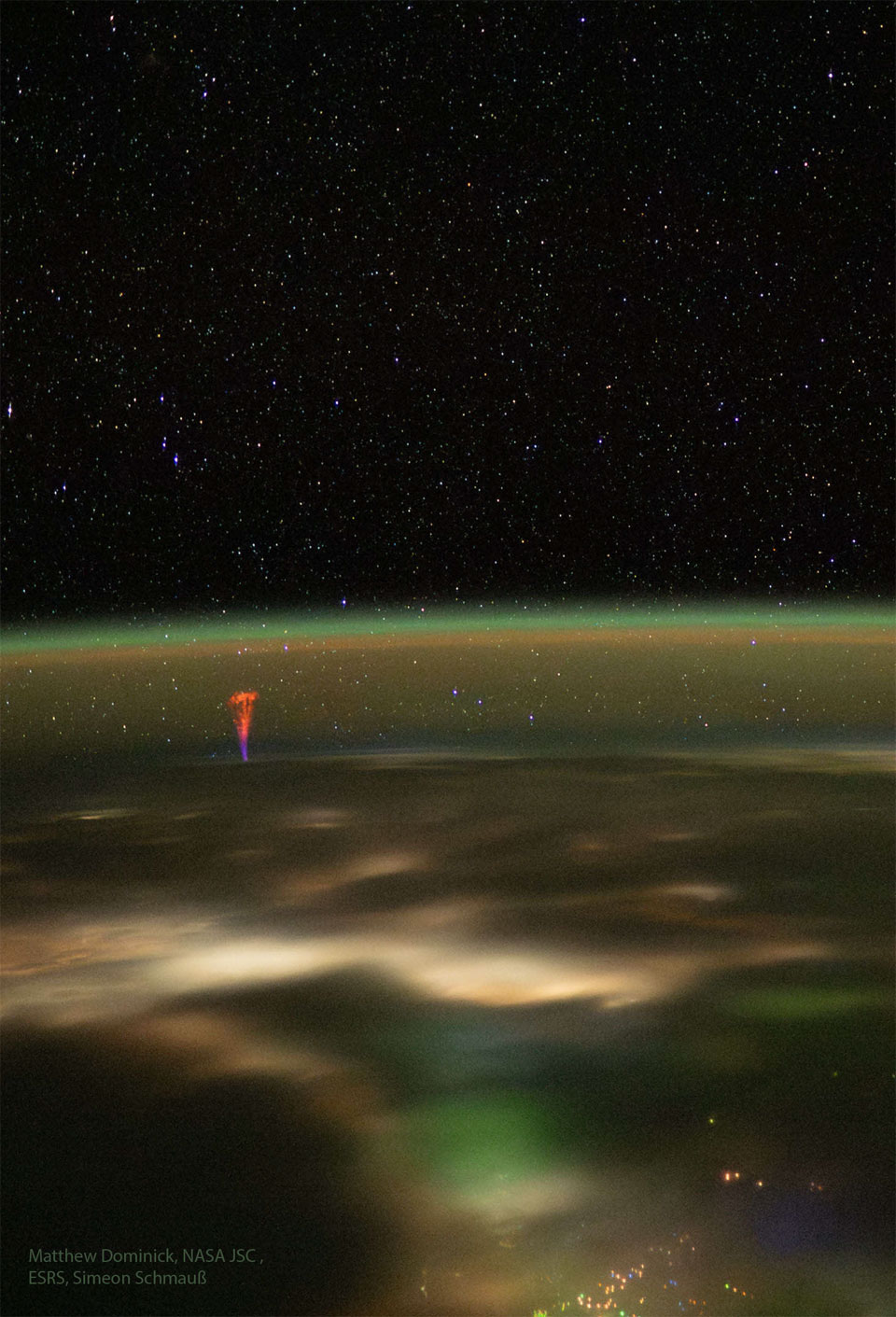
What's that on the horizon? When circling the Earth on the International Space Station early last month, astronaut Matthew Dominick saw an unusual type of lightning just beyond the Earth's edge: a gigantic jet. The powerful jet appears on the left of the featured image in red and blue. Giant jet lightning has only been known about for the past 23 years. The atmospheric jets are associated with thunderstorms and extend upwards towards Earth's ionosphere. The lower part of the frame shows the Earth at night, with Earth's thin atmosphere tinted green from airglow. City lights are visible, sometimes resolved, but usually creating diffuse white glows in intervening clouds. The top of the frame reveals distant stars in the dark night sky. The nature of gigantic jets and their possible association with other types of Transient Luminous Events (TLEs) such as blue jets and red sprites remains an active topic of research. Growing Gallery: Perseid Meteor Shower 2024 and Aurorae