International Space Station
The International Space Station (ISS) is a modular space laboratory in low Earth orbit, jointly operated by NASA, Roscosmos, ESA, JAXA, and CSA. Launched beginning in 1998, it has been continuously inhabited since November 2000 and supports cutting-edge research in microgravity, Earth observation, and space technology, while fostering international cooperation.
Source: nasa.gov
APODs including "International Space Station"
Aurora Australis and the International Space Station
13/09/2024
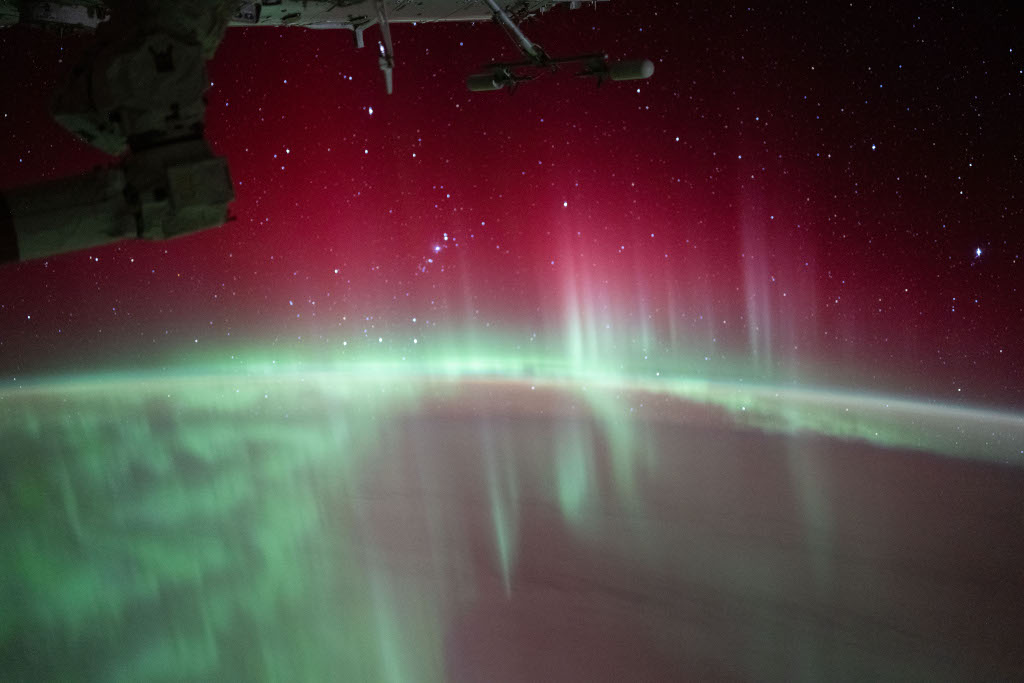
This snapshot from the International Space Station was taken on August 11 while orbiting about 430 kilometers above the Indian Ocean, Southern Hemisphere, planet Earth. The spectacular view looks south and east, down toward the planet's horizon and through red and green curtains of aurora australis. The auroral glow is caused by emission from excited oxygen atoms in the extremely rarefied upper atmosphere still present at the level of the orbiting outpost. Green emission from atomic oxygen dominates this scene at altitudes of 100 to 250 kilometers, while red emission from atomic oxygen can extend as high as 500 kilometers altitude. Beyond the glow of these southern lights, this view from low Earth orbit reveals the starry sky from a southern hemisphere perspective. Stars in Orion's belt and the Orion Nebula are near the Earth's limb just left of center. Sirius, alpha star of Canis Major and brightest star in planet Earth's night is above center along the right edge of the southern orbital skyscape. Looking Up: International Observe the Moon Night