International Space Station
The International Space Station (ISS) is a modular space laboratory in low Earth orbit, jointly operated by NASA, Roscosmos, ESA, JAXA, and CSA. Launched beginning in 1998, it has been continuously inhabited since November 2000 and supports cutting-edge research in microgravity, Earth observation, and space technology, while fostering international cooperation.
Source: nasa.gov
APODs including "International Space Station"
International Space Station Crosses the Sun
21/05/2025
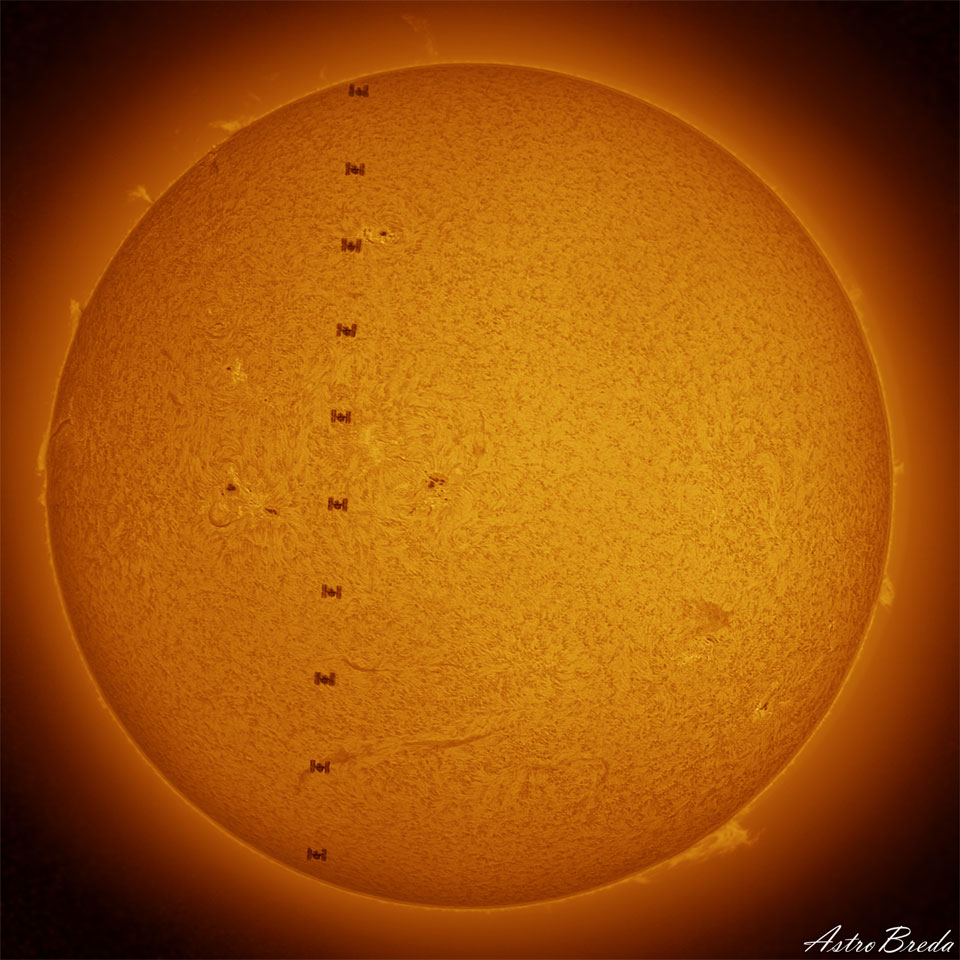
Typically, the International Space Station is visible only at night. Slowly drifting across the night sky as it orbits the Earth, the International Space Station (ISS) can be seen as a bright spot about once a month from many locations. The ISS is then visible only just after sunset or just before sunrise because it shines by reflected sunlight -- once the ISS enters the Earth's shadow, it will drop out of sight. The only occasion when the ISS is visible during the day is when it passes right in front of the Sun. Then, it passes so quickly that only cameras taking short exposures can visually freeze the ISS's silhouette onto the background Sun. The featured picture did exactly that -- it is actually a series of images taken a month ago from Sant Feliu de Buixalleu, Spain with perfect timing. This image series was later combined with a separate image highlighting the texture of the active Sun which included several Sun's prominences around the edge. Celestial Surprise: What picture did APOD feature on your birthday? (post 1995)