Irregular Galaxy
A galaxy that lacks a distinct regular shape, unlike spiral or elliptical galaxies. Irregular galaxies often result from gravitational interactions or collisions, leading to chaotic appearances without a defined structure. They typically contain abundant gas and dust, facilitating active star formation.
Source: science.nasa.gov
APODs including "Irregular Galaxy"
Deep Field: The Large Magellanic Cloud
07/03/2023
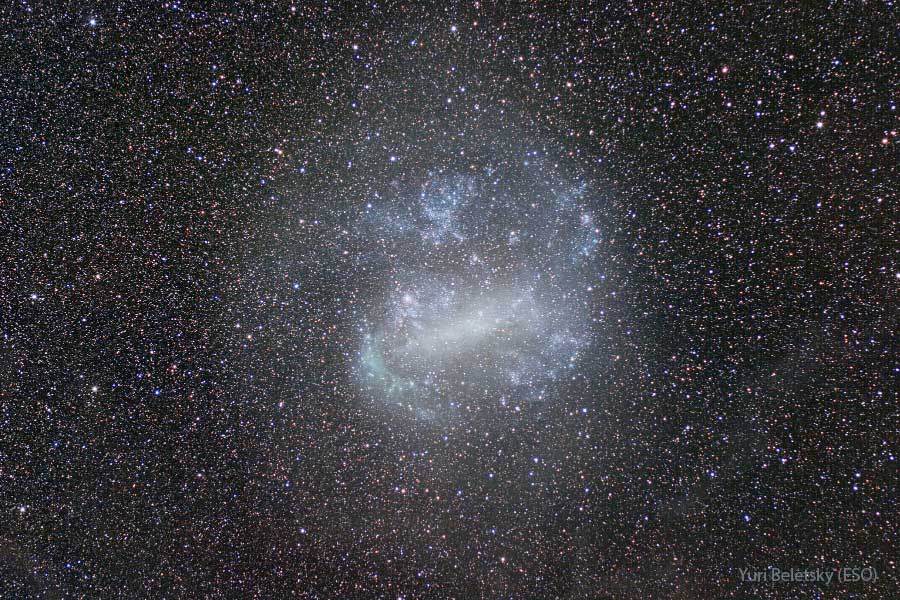
Is this a spiral galaxy? No. Actually, it is the Large Magellanic Cloud (LMC), the largest satellite galaxy of our own Milky Way Galaxy. The LMC is classified as a dwarf irregular galaxy because of its normally chaotic appearance. In this deep and wide exposure, however, the full extent of the LMC becomes visible. Surprisingly, during longer exposures, the LMC begins to resemble a barred spiral galaxy. The Large Magellanic Cloud lies only about 180,000 light-years distant towards the constellation of the Dolphinfish (Dorado). Spanning about 15,000 light-years, the LMC was the site of SN1987A, the brightest and closest supernova in modern times. Together with the Small Magellanic Cloud (SMC), the LMC can be seen in Earth's southern hemisphere with the unaided eye. Your Sky Surprise: What picture did APOD feature on your birthday? (post 1995)