Large Magellanic Cloud
The Large Magellanic Cloud (LMC) is a dwarf satellite galaxy of the Milky Way, located about 160,000–200,000 light‑years away in the southern constellations Dorado and Mensa. Roughly 10,000 light‑years across, it is rich in star-forming regions—such as the Tarantula Nebula—and contains billions of stars.
Source: science.nasa.gov
APODs including "Large Magellanic Cloud"
LMC X-1: A Black Hole Candidate
30/12/1995
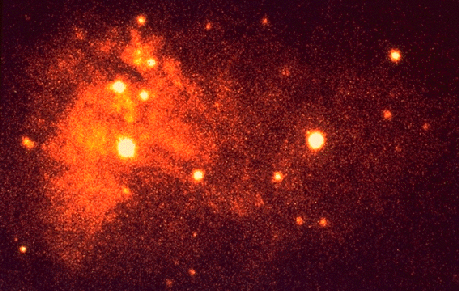
The strongest source of X-rays in the Large Magellanic Cloud originates from an unusually energetic binary star system. This strong source, dubbed LMC X-1, is thought to be a normal and compact star orbiting each other. Gas stripped of the normal star falls onto the compact star, heats up, and emits X-rays. The X-rays shining from the system knock electrons off atoms for light years around, causing some atoms to glow noticeably in X-rays when the electrons re-combine. Motion in the binary system indicates the compact star is probably a black hole, since its high mass - roughly five times that of our Sun - should be enough to cause even a neutron star to implode.