Large Magellanic Cloud
The Large Magellanic Cloud (LMC) is a dwarf satellite galaxy of the Milky Way, located about 160,000–200,000 light‑years away in the southern constellations Dorado and Mensa. Roughly 10,000 light‑years across, it is rich in star-forming regions—such as the Tarantula Nebula—and contains billions of stars.
Source: science.nasa.gov
APODs including "Large Magellanic Cloud"
A MACHO View of Galactic Dark Matter
02/02/1996
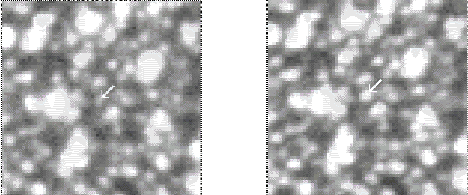
What is our Galaxy made of? Stellar motions indicate there is much more mass than just stars and gas. Photographs like the two shown above may be yielding a clue about the dark matter, however. Pictured is the first recorded instance of a dim star in our Galaxy moving in front of a bright background star, shown by the arrow, deflecting light around it, and causing the background star to appear much brighter (right frame). Were our Galaxy made predominantly of MAssive Compact Halo Objects (MACHOs), many similar such gravitational lensing events would be expected when photographing the Large Magellanic Clouds (LMC) - hence indicating the presence of MACHO lenses in our Galaxy. A research team led by Charles Alcock this month claimed enough LMC gravitational lensing events to indicate at least half of the dark matter in our Galaxy is composed of MACHOs. This spectacular claim may well be correct - but awaits crucial testing with future observations and modeling.