Large Magellanic Cloud
The Large Magellanic Cloud (LMC) is a dwarf satellite galaxy of the Milky Way, located about 160,000–200,000 light‑years away in the southern constellations Dorado and Mensa. Roughly 10,000 light‑years across, it is rich in star-forming regions—such as the Tarantula Nebula—and contains billions of stars.
Source: science.nasa.gov
APODs including "Large Magellanic Cloud"
The Closest Galaxy: The Sagittarius Dwarf
04/02/1996
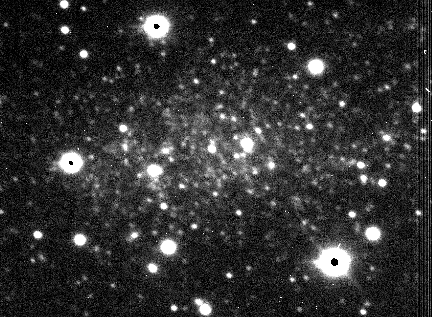
What's the closest galaxy to our Milky Way? For many years astronomers thought it was the Large Magellanic Cloud (LMC). But the seemingly insignificant fuzzy patch shown above turned out to be part of a galaxy that is even closer. Deemed the "Sagittarius Dwarf", this small galaxy went unnoticed until its discovery in 1994 by R. Ibata, G. Gilmore and M. Irwin (RGO). The reason the Sagittarius Dwarf hadn't been discovered earlier is because it is so dim, it is so spread out over the sky, and there are so many Milky Way stars in front of it. The distance to the Sagittarius Dwarf was recently measured to be about one third of the distance to the LMC. Astronomers now believe that this galaxy is slowly being torn apart by the vast gravitational forces of our Galaxy.