Large Magellanic Cloud
The Large Magellanic Cloud (LMC) is a dwarf satellite galaxy of the Milky Way, located about 160,000–200,000 light‑years away in the southern constellations Dorado and Mensa. Roughly 10,000 light‑years across, it is rich in star-forming regions—such as the Tarantula Nebula—and contains billions of stars.
Source: science.nasa.gov
APODs including "Large Magellanic Cloud"
Supernova Remnant: Cooking Elements In The LMC
09/05/1996
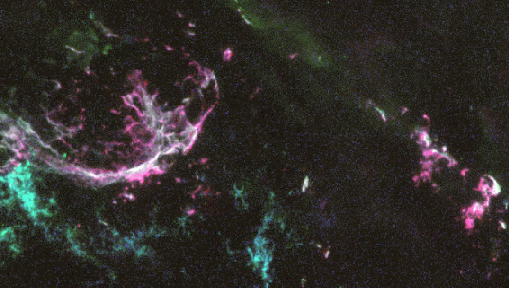
Massive stars cook elements in their cores through nuclear fusion. Starting with the light elements of hydrogen and helium, their central temperatures and pressures produce progressively heavier elements, carbon, oxygen, nitrogen, etc. up through iron. At the end of their lives they explode in a spectacular supernova, scattering these elements into space, contributing material to the formation of other stars and star systems. In fact, the elements making up life on Earth were baked in such a stellar oven! This Hubble Space Telescope image of a supernova remnant known as N132D in the Large Magellanic Cloud (LMC) allows astronomers to explore the details of this nuclear processing and mixing. It reveals luminous clouds of cooked supernova debris energized by shocks -- singly ionized sulfur appears red, doubly ionized oxygen, green, and singly ionized oxygen, blue. The region shown above is about 50 lightyears across.