Large Magellanic Cloud
The Large Magellanic Cloud (LMC) is a dwarf satellite galaxy of the Milky Way, located about 160,000–200,000 light‑years away in the southern constellations Dorado and Mensa. Roughly 10,000 light‑years across, it is rich in star-forming regions—such as the Tarantula Nebula—and contains billions of stars.
Source: science.nasa.gov
APODs including "Large Magellanic Cloud"
The Large Cloud of Magellan (LMC) Credit:
23/10/1996
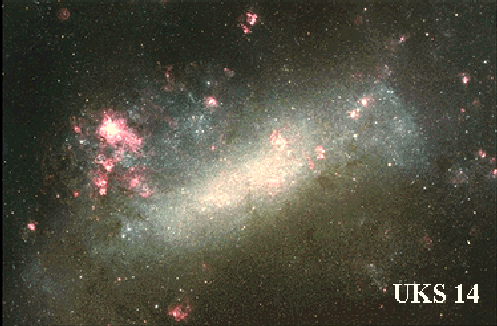
Magellan and his crew had plenty of time to study the southern sky during their famous voyage around the world. As a result, two fuzzy cloud like objects in the southern sky are now known as the Clouds of Magellan. These star clouds are small irregular galaxies, satellites of our larger Milky Way spiral galaxy. The Large Magellanic Cloud (LMC) pictured above is only about 180,000 light-years distant - the only known galaxy closer is the Sagittarius Dwarf. Both the LMC and the Small Magellanic Clouds (SMC) are joined to the Milky Way by a stream of cold hydrogen gas whose origin is still controversial. An unusual effect called gravitational lensing has recently been detected in a few LMC stars, and there is hope this could tell us important information about the true composition of our universe.