Large Magellanic Cloud
The Large Magellanic Cloud (LMC) is a dwarf satellite galaxy of the Milky Way, located about 160,000–200,000 light‑years away in the southern constellations Dorado and Mensa. Roughly 10,000 light‑years across, it is rich in star-forming regions—such as the Tarantula Nebula—and contains billions of stars.
Source: science.nasa.gov
APODs including "Large Magellanic Cloud"
Supernova 1987a Fireball Resolved Credit:
24/01/1997
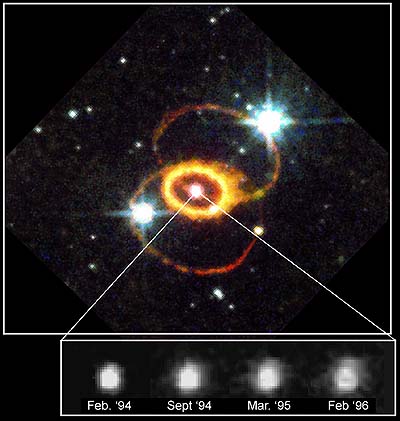
Ten years ago the most notable supernova of modern times was observed. In February 1987, light reached Earth from a star which exploded in the nearby Large Magellanic Cloud galaxy. Supernova 1987a remains the closest supernova since the invention of the telescope. The explosion catapulted a tremendous amount of gas, light, and neutrinos into interstellar space. When observed by the Hubble Space Telescope (HST) in 1994, large strange rings were discovered whose origin is still mysterious, although thought to have been expelled even before the main explosion. More recent HST observations shown in the inset, however, have uncovered something actually predicted: the expanding fireball from the exploding star. The above high resolution images resolve two blobs flung out from the central explosion.