Large Magellanic Cloud
The Large Magellanic Cloud (LMC) is a dwarf satellite galaxy of the Milky Way, located about 160,000–200,000 light‑years away in the southern constellations Dorado and Mensa. Roughly 10,000 light‑years across, it is rich in star-forming regions—such as the Tarantula Nebula—and contains billions of stars.
Source: science.nasa.gov
APODs including "Large Magellanic Cloud"
Supernova Remnant N132D in X-Rays
13/09/1999
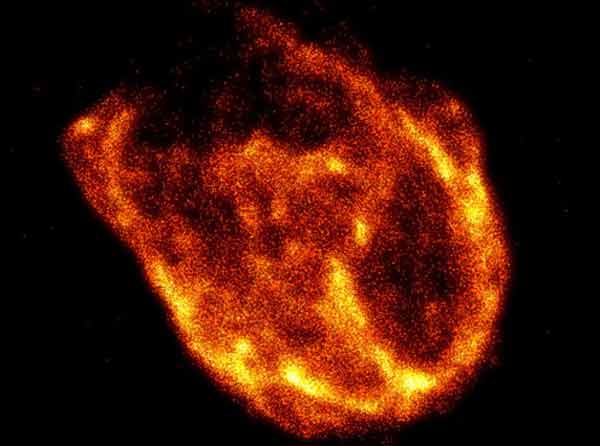
Thousands of years after a star explodes, an expanding remnant may still glow brightly. Such is the case with N132D, a supernova remnant located in the neighboring Large Magellanic Cloud galaxy. The expanding shell from this explosion now spans 80 light-years and has swept up about 600 Suns worth of mass. The bright regions surrounding the lower right of this X-ray image result from a collision with an even more massive molecular cloud. Towards the upper left, the supernova remnant expands more rapidly into less dense region of space. This image is one of the first ever taken with the High Resolution Camera onboard the orbiting Chandra X-ray Observatory, and records details being analyzed for the first time.