Large Magellanic Cloud
The Large Magellanic Cloud (LMC) is a dwarf satellite galaxy of the Milky Way, located about 160,000–200,000 light‑years away in the southern constellations Dorado and Mensa. Roughly 10,000 light‑years across, it is rich in star-forming regions—such as the Tarantula Nebula—and contains billions of stars.
Source: science.nasa.gov
APODs including "Large Magellanic Cloud"
A Magellanic Starfield
13/12/1999
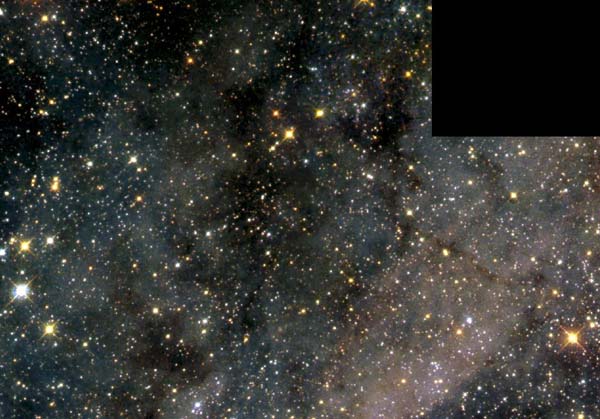
Stars of many types and colors are visible in this Hubble Space Telescope vista of the Large Magellanic Cloud (LMC). Over 10,000 stars are visible -- the brightest of which are giant stars. Were our Sun 170,000 light-years distant and among these stars, it would hardly be discernable. By contrast, only a few thousand stars are individually visible at night with the unaided eye, and many of these lie within only a few hundred light-years. Typically, the light we see from nearby stars left during the age of our great-grand-parents, while light from LMC stars started its journey before the dawn of recorded human history.