Large Magellanic Cloud
The Large Magellanic Cloud (LMC) is a dwarf satellite galaxy of the Milky Way, located about 160,000–200,000 light‑years away in the southern constellations Dorado and Mensa. Roughly 10,000 light‑years across, it is rich in star-forming regions—such as the Tarantula Nebula—and contains billions of stars.
Source: science.nasa.gov
APODs including "Large Magellanic Cloud"
The Aquarius Dwarf
27/07/2003
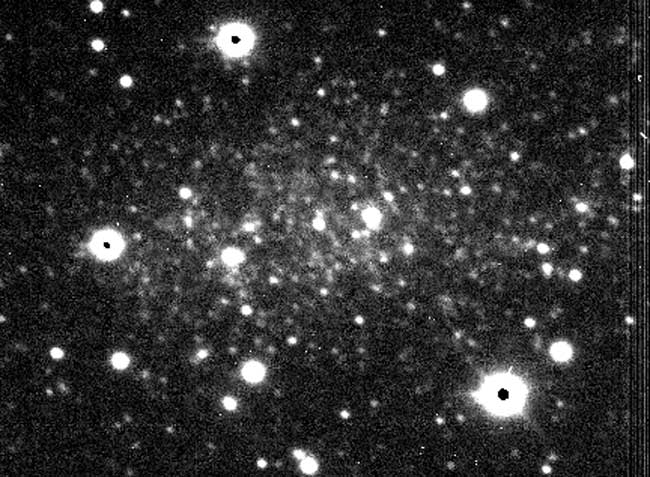
Our Milky Way Galaxy is not alone. It is part of a gathering of about 50 galaxies known as the Local Group. Members include the Great Andromeda Galaxy (M31), M32, M33, the Large Magellanic Cloud, the Small Magellanic Cloud, Dwingeloo 1, several small irregular galaxies, and many dwarf elliptical and dwarf spheroidal galaxies. Pictured above is the Aquarius Dwarf, a faint dwarf irregular galaxy over 3 million light years away. An earlier APOD erroneously identified the above image as the Sagittarius Dwarf.