Large Magellanic Cloud
The Large Magellanic Cloud (LMC) is a dwarf satellite galaxy of the Milky Way, located about 160,000–200,000 light‑years away in the southern constellations Dorado and Mensa. Roughly 10,000 light‑years across, it is rich in star-forming regions—such as the Tarantula Nebula—and contains billions of stars.
Source: science.nasa.gov
APODs including "Large Magellanic Cloud"
N11B: Star Cloud of the LMC
07/07/2004
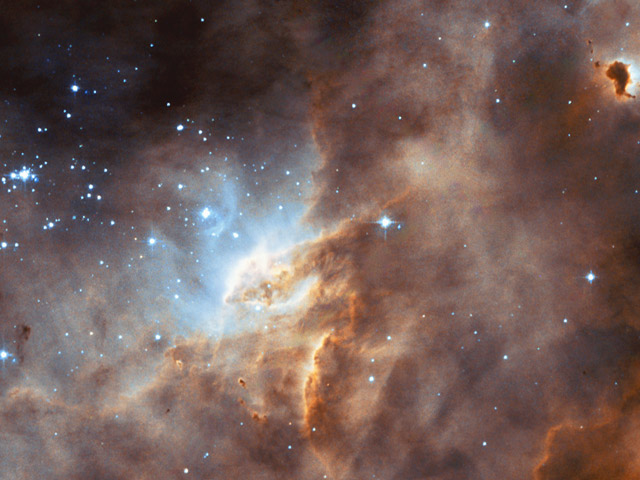
Massive stars, abrasive winds, mountains of dust, and energetic light sculpt one of the largest and most picturesque regions of star formation in the Local Group of Galaxies. Known as N11, the region is visible on the upper right of many images of its home galaxy, the Milky Way neighbor known as the Large Magellanic Clouds (LMC). The above image actually highlights N11B, part of the nebula that spans about 100 light years and is particularly active. The entire emission nebula N11 is second in LMC size only to 30 Doradus. Studying the stars in N11B has shown that it actually houses three successive generations of star formation. Compact globules of dark dust housing emerging young stars are also visible on the upper right.