Large Magellanic Cloud
The Large Magellanic Cloud (LMC) is a dwarf satellite galaxy of the Milky Way, located about 160,000–200,000 light‑years away in the southern constellations Dorado and Mensa. Roughly 10,000 light‑years across, it is rich in star-forming regions—such as the Tarantula Nebula—and contains billions of stars.
Source: science.nasa.gov
APODs including "Large Magellanic Cloud"
Tentacles of the Tarantula Nebula
28/12/2004
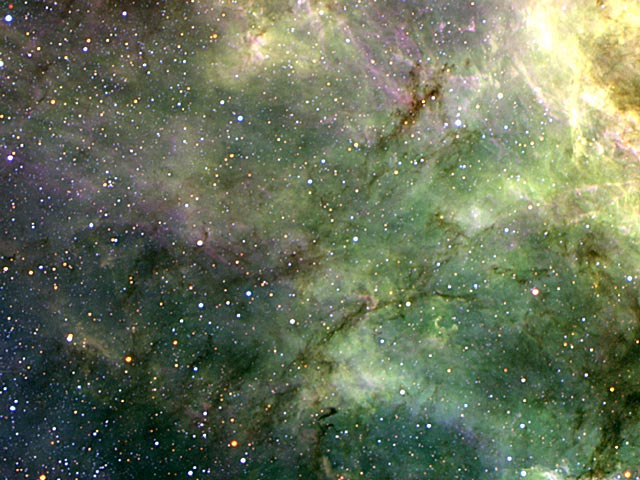
The Tarantula Nebula is a giant emission nebula within our neighboring galaxy the Large Magellanic Cloud. Inside this cosmic arachnid lies a huge central young cluster of massive stars, cataloged as R136 and partially visible on the upper right. The energetic light and winds from this cluster light up the nebula and sculpt the surrounding gas and dust into vast complex filaments. These "tentacles" give the Tarantula Nebula its name. In this impressive color image from the Wide-Field Imager camera on ESO's 2.2-meter telescope at La Silla Observatory, intricacies of the nebula's complex array of dust and gas are visible. A 300 light-year portion of the Tarantula Nebula is imaged. The Tarantula Nebula, also dubbed 30 Doradus, lies 170,000 light years away toward the constellation of Dorado.