Large Magellanic Cloud
The Large Magellanic Cloud (LMC) is a dwarf satellite galaxy of the Milky Way, located about 160,000–200,000 light‑years away in the southern constellations Dorado and Mensa. Roughly 10,000 light‑years across, it is rich in star-forming regions—such as the Tarantula Nebula—and contains billions of stars.
Source: science.nasa.gov
APODs including "Large Magellanic Cloud"
Supernova Remnant N132D in Optical and X Rays
25/10/2005
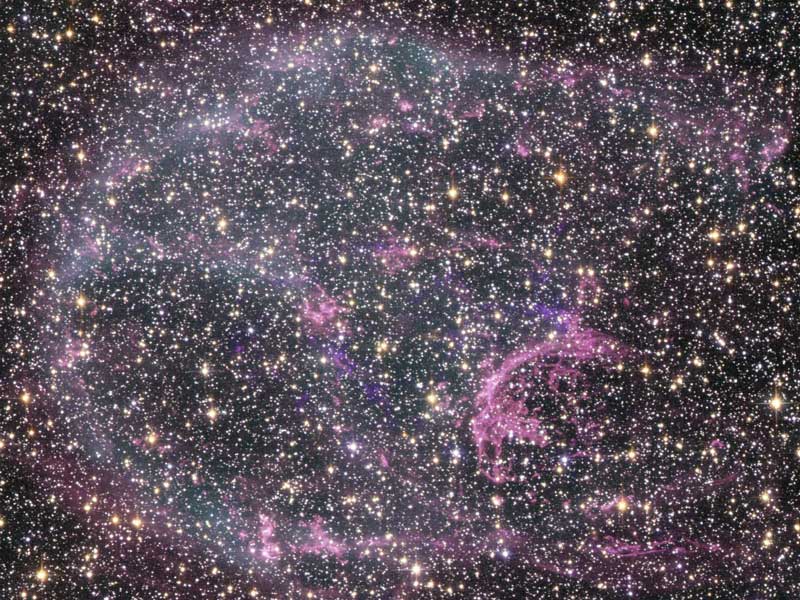
Thousands of years after a star exploded, its expanding remnant still glows brightly across the spectrum. Such is the case with N132D, a supernova remnant located in the neighboring Large Magellanic Cloud (LMC) galaxy. The expanding shell from this explosion now spans 80 light-years and has swept up about 600 Suns worth of mass. N132D was imaged recently in optical light and in great detail with the Hubble Space Telescope. The Hubble image was then combined with a position coincident detailed image in X-ray light taken by the Chandra X-ray Observatory. The combination, shown above in representative colors, shows a nearly spherical expanding shockwave highlighted by pink emission from hydrogen gas and purple emission from oxygen gas. A dense field of unrelated stars also from the LMC populates the image. Studying the image gives an opportunity to study material once hidden deep inside a star. N132D spans about 150 light years and lies about 160,000 light years away toward the constellation of Dorado.