Large Magellanic Cloud
The Large Magellanic Cloud (LMC) is a dwarf satellite galaxy of the Milky Way, located about 160,000–200,000 light‑years away in the southern constellations Dorado and Mensa. Roughly 10,000 light‑years across, it is rich in star-forming regions—such as the Tarantula Nebula—and contains billions of stars.
Source: science.nasa.gov
APODs including "Large Magellanic Cloud"
Star Forming Region LH 95
12/03/2008
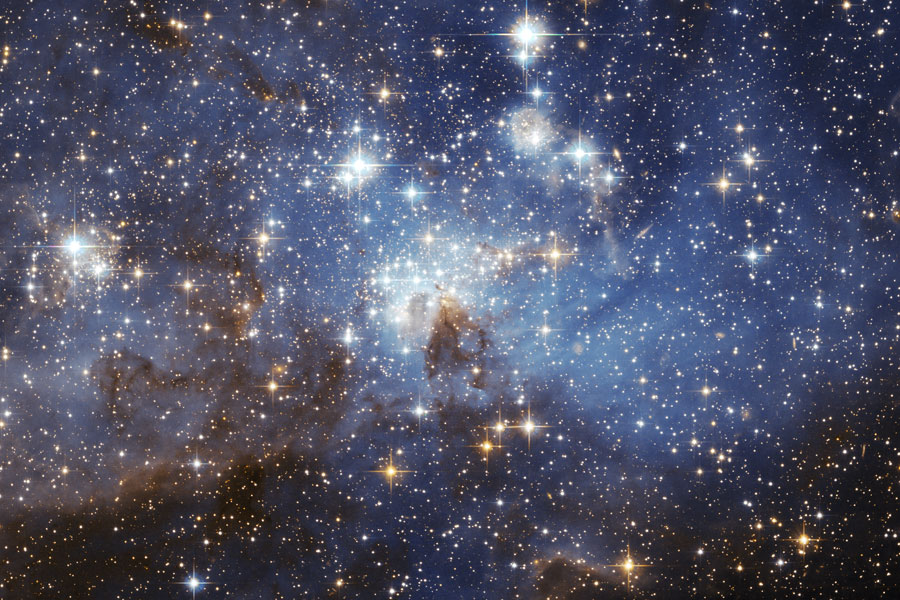
How do stars form? To better understand this complex and chaotic process, astronomers used the Hubble Space Telescope to image in unprecedented detail the star forming region LH 95 in the nearby Large Magellanic Cloud galaxy. Usually only the brightest, bluest, most massive stars in a star forming region are visible, but the above image was taken in such high resolution and in such specific colors that many recently formed stars that are more yellow, more dim, and less massive are also discernable. Also visible in the above scientifically colored image is a blue sheen of diffuse hydrogen gas heated by the young stars, and dark dust created by stars or during supernova explosions. Studying the locations and abundances of lower mass stars in star forming regions and around molecular clouds helps uncover what conditions were present when they formed. LH 95 spans about 150 light years and lies about 160,000 light years away toward the southern constellation of the Swordfish (Dorado).