Large Magellanic Cloud
The Large Magellanic Cloud (LMC) is a dwarf satellite galaxy of the Milky Way, located about 160,000–200,000 light‑years away in the southern constellations Dorado and Mensa. Roughly 10,000 light‑years across, it is rich in star-forming regions—such as the Tarantula Nebula—and contains billions of stars.
Source: science.nasa.gov
APODs including "Large Magellanic Cloud"
The N44 Complex
27/03/2008
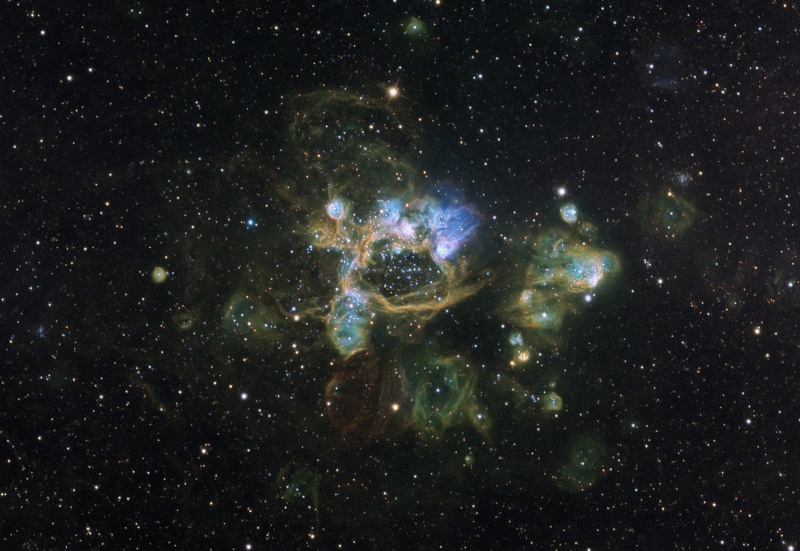
A truly giant complex of emission nebulae, N44 is about 1,000 light-years across. It shines in southern skies as a denizen of our neighboring galaxy, the Large Magellanic Cloud, 170,000 light-years away. Winds and intense radiation from hot, young, luminous stars in N44 excite and sculpt filaments and streamers of the glowing nebular gas. But supernovae - the death explosions of the massive short lived stars - have also likely contributed to the region's enormous, blown-out shapes. The cluster of young stars seen near the center lies in a superbubble nearly 250 light-years across. This detailed, false-color view of the intricate structures codes emission from hydrogen, oxygen, and sulfur in shades of blue and green.