Large Magellanic Cloud
The Large Magellanic Cloud (LMC) is a dwarf satellite galaxy of the Milky Way, located about 160,000–200,000 light‑years away in the southern constellations Dorado and Mensa. Roughly 10,000 light‑years across, it is rich in star-forming regions—such as the Tarantula Nebula—and contains billions of stars.
Source: science.nasa.gov
APODs including "Large Magellanic Cloud"
NGC 4449: Close-up of a Small Galaxy
25/02/2011
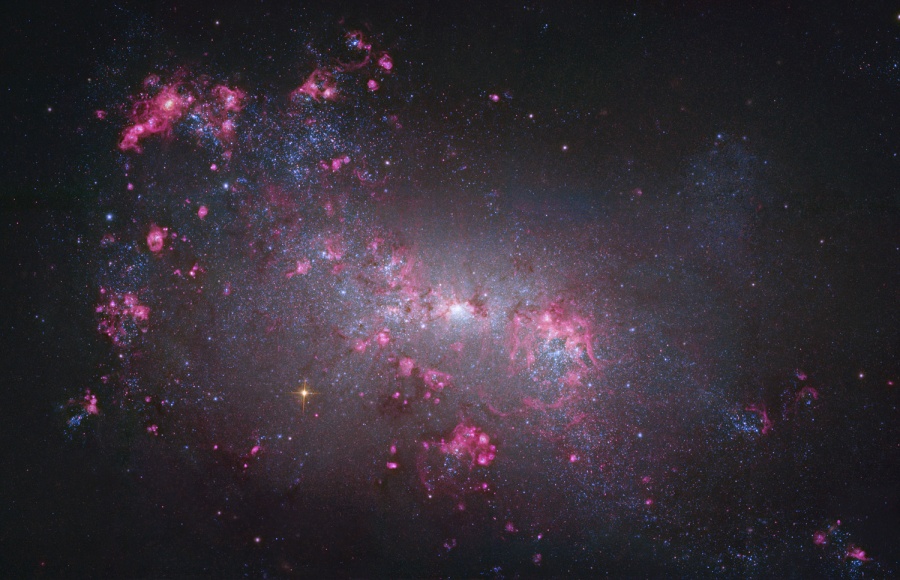
Grand spiral galaxies often seem to get all the glory. Their young, blue star clusters and pink star forming regions along sweeping spiral arms are guaranteed to attract attention. But small irregular galaxies form stars too, like NGC 4449, about 12 million light-years distant. Less than 20,000 light-years across, the small island universe is similar in size, and often compared to our Milky Way's satellite galaxy, the Large Magellanic Cloud (LMC). This remarkable Hubble Space Telescope close-up of the well-studied galaxy was reprocessed to highlight the telltale reddish glow of hydrogen gas. The glow traces NGC 4449's widespread star forming regions, some even larger than those in the LMC, with enormous interstellar arcs and bubbles blown by short-lived, massive stars. NGC 4449 is a member of a group of galaxies found in the constellation Canes Venatici. Interactions with the nearby galaxies are thought to have influenced star formation in NGC 4449.