Large Magellanic Cloud
The Large Magellanic Cloud (LMC) is a dwarf satellite galaxy of the Milky Way, located about 160,000–200,000 light‑years away in the southern constellations Dorado and Mensa. Roughly 10,000 light‑years across, it is rich in star-forming regions—such as the Tarantula Nebula—and contains billions of stars.
Source: science.nasa.gov
APODs including "Large Magellanic Cloud"
Spiral Galaxy NGC 6744
10/08/2018
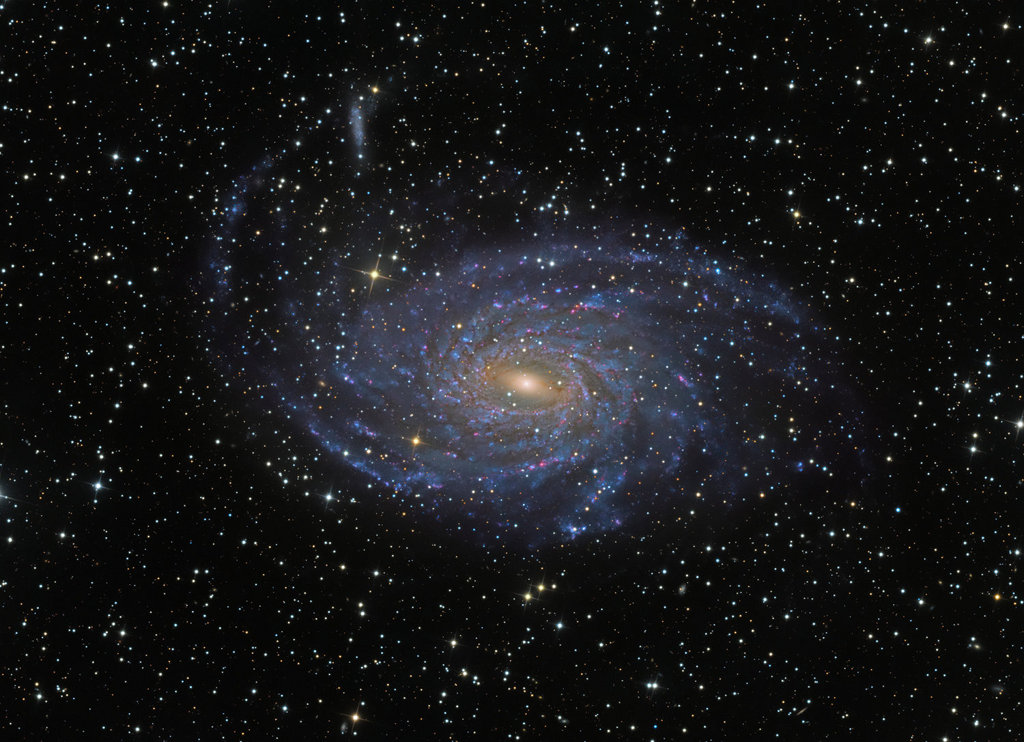
Beautiful spiral galaxy NGC 6744 is nearly 175,000 light-years across, larger than our own Milky Way. It lies some 30 million light-years distant in the southern constellation Pavo and appears as only a faint, extended object in small telescopes. We see the disk of the nearby island universe tilted towards our line of sight. This remarkably detailed galaxy portrait covers an area about the angular size of the full moon. In it, the giant galaxy's elongated yellowish core is dominated by the light from old, cool stars. Beyond the core, grand spiral arms are filled with young blue star clusters and speckled with pinkish star forming regions. An extended arm sweeps past a smaller satellite galaxy at the upper left. NGC 6744's galactic companion is reminiscent of the Milky Way's satellite galaxy the Large Magellanic Cloud. This Weekend: Meteor showers expected, Moon bites Sun (again)