Large Magellanic Cloud
The Large Magellanic Cloud (LMC) is a dwarf satellite galaxy of the Milky Way, located about 160,000–200,000 light‑years away in the southern constellations Dorado and Mensa. Roughly 10,000 light‑years across, it is rich in star-forming regions—such as the Tarantula Nebula—and contains billions of stars.
Source: science.nasa.gov
APODs including "Large Magellanic Cloud"
Ghost Fungus to Magellanic Cloud
23/05/2020
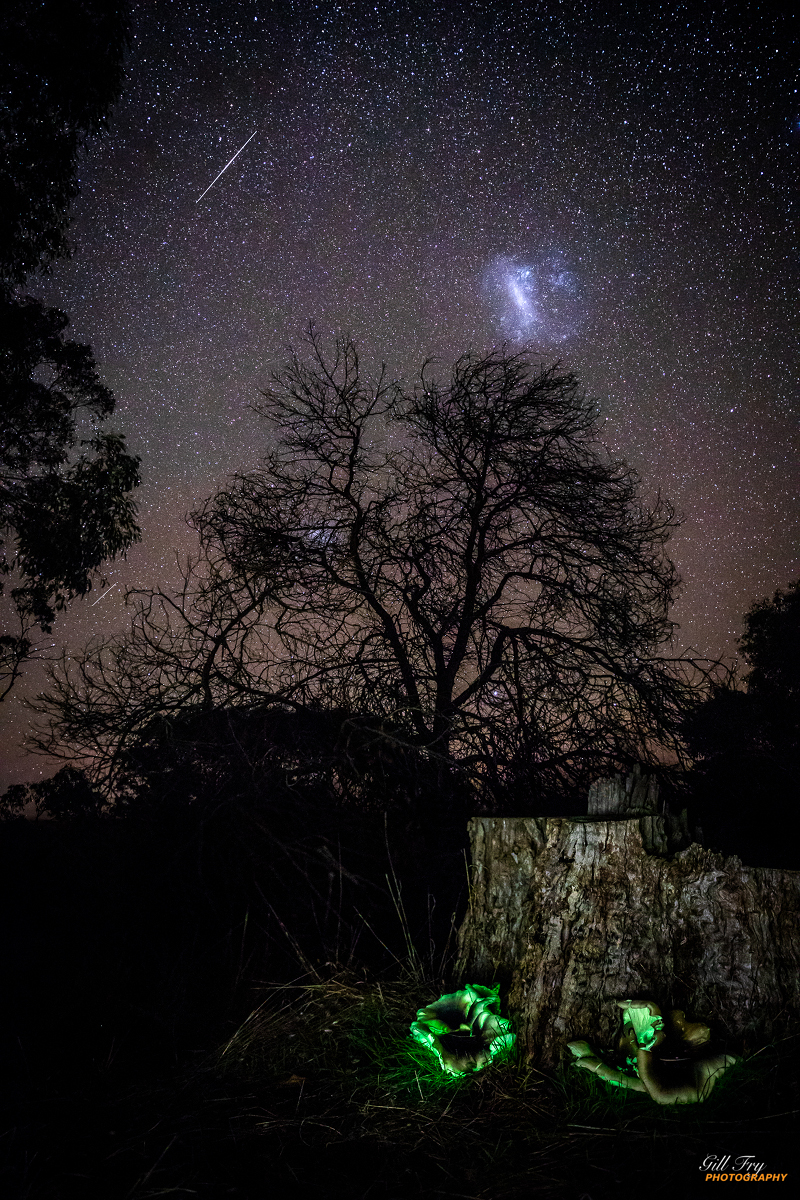
Stars shine and satellites glint in this clear, dark, night sky over Wannon Falls Reserve, South West Victoria, Australia. In fact the fuzzy, faint apparition above the tree tops is the only cloud visible, also known as the Large Magellanic Cloud, satellite galaxy of our own Milky Way. In the foreground, an Omphalotus nidiformis (ghost fungus) from planet Earth shines with a surprisingly bright bioluminescence. Like the Magellanic cloud, the ghost fungus was easily seen with the eye. Its ghostly glow was actually a dull green, but it appears bright green in digital camera picture. Two images were blended to create the scene. One focused on the distant stars and Large Magellanic Cloud some 160,000 light-years away. Another was focused on the foreground and glowing fungus several light-nanoseconds from the camera lens.