Large Magellanic Cloud
The Large Magellanic Cloud (LMC) is a dwarf satellite galaxy of the Milky Way, located about 160,000–200,000 light‑years away in the southern constellations Dorado and Mensa. Roughly 10,000 light‑years across, it is rich in star-forming regions—such as the Tarantula Nebula—and contains billions of stars.
Source: science.nasa.gov
APODs including "Large Magellanic Cloud"
NGC 604: Giant Stellar Nursery
25/04/2024
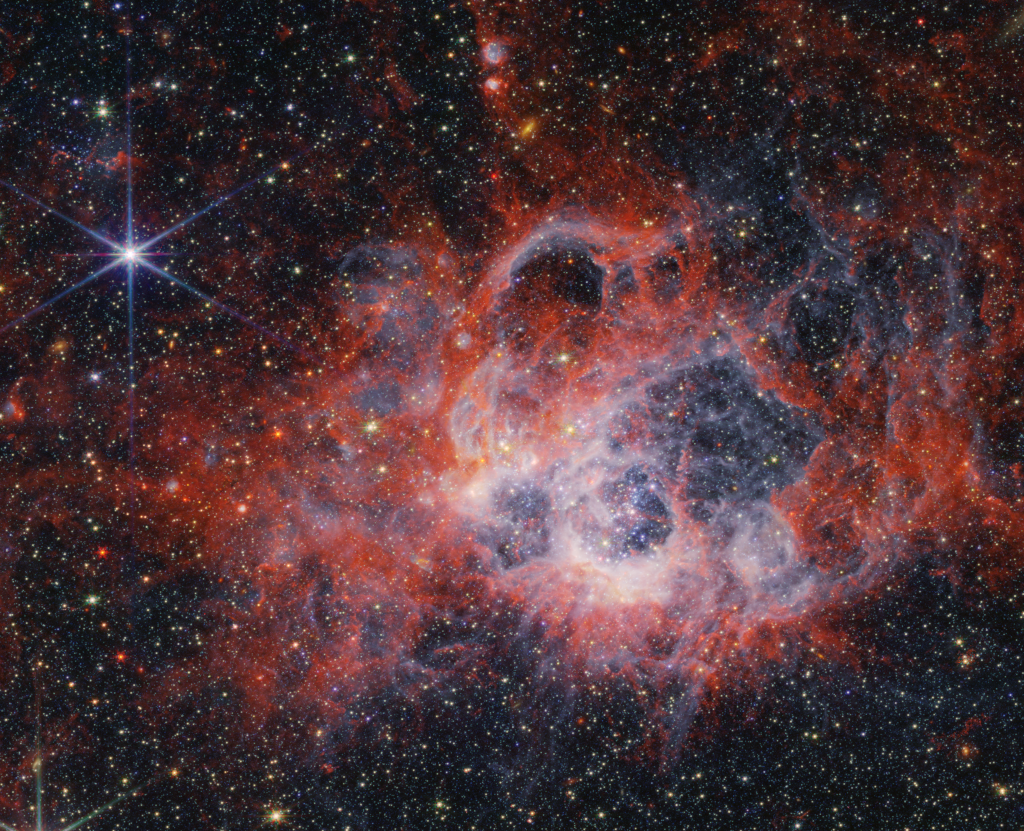
Located some 3 million light-years away in the arms of nearby spiral galaxy M33, giant stellar nursery NGC 604 is about 1,300 light-years across. That's nearly 100 times the size of the Milky Way's Orion Nebula, the closest large star forming region to planet Earth. In fact, among the star forming regions within the Local Group of galaxies, NGC 604 is second in size only to 30 Doradus, also known as the Tarantula Nebula in the Large Magellanic Cloud. Cavernous bubbles and cavities in NGC 604 fill this stunning infrared image from the James Webb Space Telescope's NIRCam. They are carved out by energetic stellar winds from the region's more than 200 hot, massive, young stars, all still in early stages of their lives.