Large Magellanic Cloud
The Large Magellanic Cloud (LMC) is a dwarf satellite galaxy of the Milky Way, located about 160,000–200,000 light‑years away in the southern constellations Dorado and Mensa. Roughly 10,000 light‑years across, it is rich in star-forming regions—such as the Tarantula Nebula—and contains billions of stars.
Source: science.nasa.gov
APODs including "Large Magellanic Cloud"
The Large Magellanic Cloud Galaxy
02/10/2024
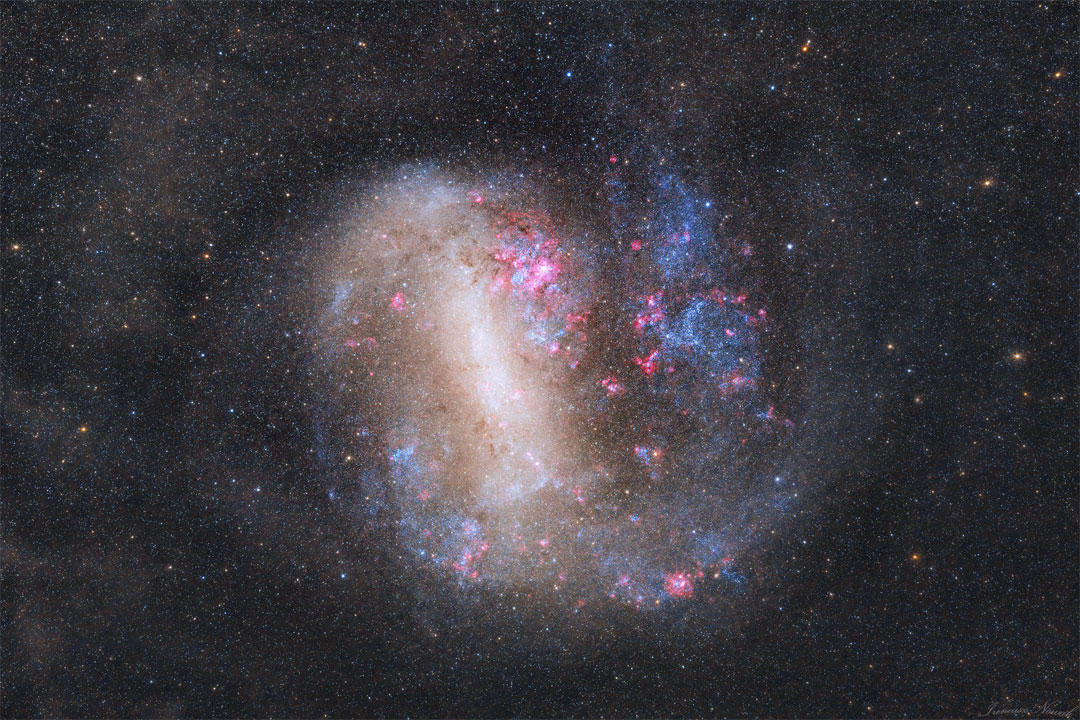
It is the largest satellite galaxy of our home Milky Way Galaxy. If you live in the south, the Large Magellanic Cloud (LMC) is quite noticeable, spanning about 10 degrees across the night sky, which is 20 times larger than the full moon towards the southern constellation of the dolphinfish (Dorado). Being only about 160,000 light years away, many details of the LMC's structure can be seen, such as its central bar and its single spiral arm. The LMC harbors numerous stellar nurseries where new stars are being born, which appear in pink in the featured image. It is home to the Tarantula Nebula, the currently most active star forming region in the entire Local Group, a small collection of nearby galaxies dominated by the massive Andromeda and Milky Way galaxies. Studies of the LMC and the Small Magellanic Cloud (SMC) by Henrietta Swan Leavitt led to the discovery of the period-luminosity relationship of Cepheid variable stars that are used to measure distances across the nearby universe. Survey: Color Blindness and Astronomical Images