Large Magellanic Cloud
The Large Magellanic Cloud (LMC) is a dwarf satellite galaxy of the Milky Way, located about 160,000–200,000 light‑years away in the southern constellations Dorado and Mensa. Roughly 10,000 light‑years across, it is rich in star-forming regions—such as the Tarantula Nebula—and contains billions of stars.
Source: science.nasa.gov
APODs including "Large Magellanic Cloud"
NGC 55: A Galaxy of Nebulas
26/01/2026
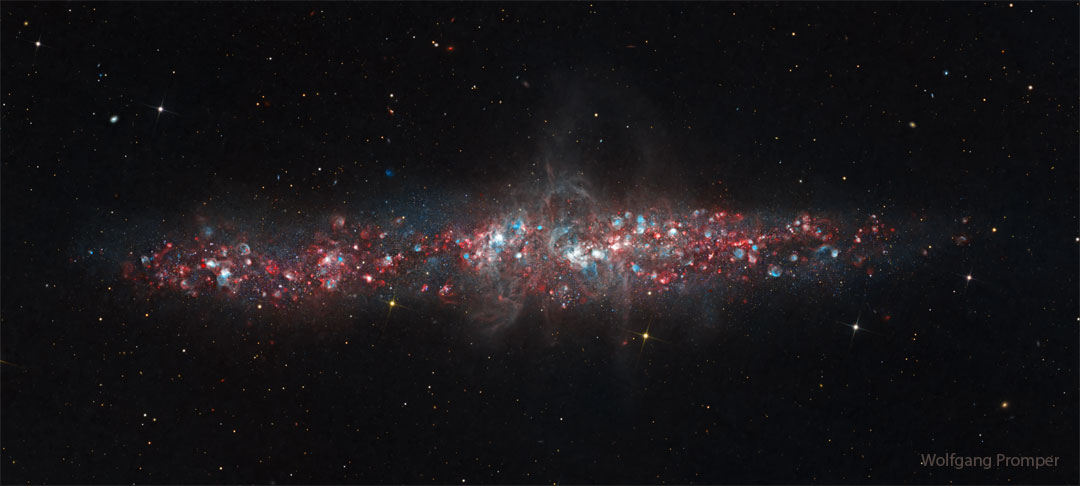
Can you see nebulas in other galaxies? Yes, some nebulas shine brightly enough -- if you know how to look. Clouds of hydrogen and oxygen emit light at very specific colors, and by isolating them, astronomers and astrophotographers can reveal structures that would otherwise be too faint to notice. This deep, 50-hour exposure highlights glowing hydrogen (red) and oxygen (blue) across galaxy NGC 55, viewed nearly edge-on. Also known as the String of Pearls Galaxy, NGC 55 is often compared to our Milky Way's satellite galaxy the Large Magellanic Cloud (LMC), although NGC 55 lies much farther away at about 6.5 million light-years. The resulting image uncovers a sprinkling of emission nebulas within and sometimes above the galaxy's dusty disk, offering a detailed look at distant star-forming regions. Jigsaw Galaxy: Astronomy Puzzle of the Day