Mars
Mars is the fourth planet from the Sun and the seventh largest in the Solar System. A cold, dusty desert world with a thin atmosphere (mostly CO₂), the planet features extinct volcanoes, deep canyons, polar ice caps, and seasons. Mars has two small moons (Phobos and Deimos), a day just over 24 hours long, and a year lasting about 687 Earth days. It is a prime focus of robotic exploration and studies about past water and habitability.
Source: science.nasa.gov
APODs including "Mars"
The Search for Life on Mars
21/07/1995
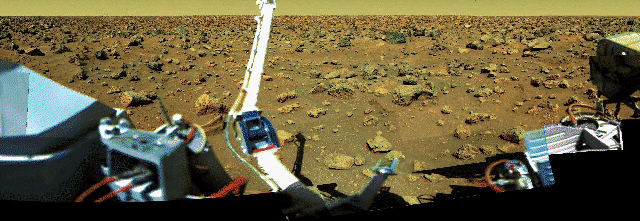
July 21, 1995 The Search for Life on Mars Picture Credit: NASA,Viking Project, Explanation: Although images of Mars taken from space revealed the planet to have a barren and cratered surface, scientists did not give up the search for martian life. In 1976 NASA's Viking project succeeded in landing two robot probes on the surface of Mars. These landers were able to carry out sophisticated chemical experiments to look for signs of microscopic life in the martian soil. However, the experiments failed to produce any convincing evidence for life on Mars. Cameras onboard the Viking Landers also returned spectacular photos of the rocky martian landscape, like the one above, which showed no sign of martian animal or plant life. For more information about the picture see The NSSDC Mars Photo Gallery. The exploration of Mars is chronicled by the Center For Mars Exploration. We keep an archive of Astronomy Pictures of the Day. Astronomy Picture of the Day is brought to you by Robert Nemiroff and Jerry Bonnell . Original material on this page is copyrighted to Robert J. Nemiroff and Jerry T. Bonnell.